
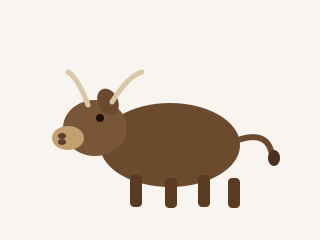
Meat
Beef
Beef is among the most widely eaten meats in the world, prized for its rich umami flavour, suitability across roasting, grilling, braising, and curing, and the wide range of cuts available from premium steaks to economical braising joints. Breed, finishing method, and ageing all strongly influence tenderness, marbling, and flavour. From Sunday roasts to restaurant chateaubriand, beef anchors cuisines across Europe, the Americas, Africa, and Asia. Understanding cuts, breeds, and provenance helps match the right product to slow cooking, quick searing, or charcuterie.
Track this ingredient
Cuts & parts
Back Ribs

Bavette
Bone
Bottom Round

Brain

Brisket

Chateaubriand

Cheek

Chuck

Clod
Club Steak

Coulotte

Cowboy Cut

Denver Cut
Eye of Round
Fat

Feather Blade
Fillet

Flank

Flat Iron

Forequarter
Ground

Hanger

Heart

Heel

Hindquarter

Kidney

Knuckle

Liver
Mince

Neck

Onglet

Oxtail

Oyster Blade

Picanha

Plate

Porterhouse

Prime Rib

Ribeye

Round

Rump
Scotch Fillet

Shank

Shin
Short Rib

Silverside
Sirloin

Skirt

Spleen
Striploin

Sweetbread
T-Bone
Tenderloin

Testicle

Tomahawk

Tongue

Topside

Tri-Tip

Tripe

Udder
Breeds & varieties
A sample of named types with their own origin and culinary profiles. Showing 10 of 86.


Characteristics
Preparations
Provenance
Sources
Traits
Nutrition and pairings
Nutrition
Typical values per 100 g edible portion. Nutrient names open the reference page.
Nutrition Facts
Per 100 g edible portion
Amount per 100 g
- Total Fat 12.5 g
- Saturated Fat 4.83 g
- Trans Fat 0.2 g
- Monounsaturated Fat 4.89 g
- Polyunsaturated Fat 1.03 g
- Cholesterol 72.8 mg
- Sodium 59.6 mg
- Salt 0.15 g
- Total Carbohydrate 0 g
- Dietary Fibre 0 g
- Total Sugars 0 g
- Complex / starch 0 g
- Protein 22.1 g
- Water 63.6 g
- Energy 196 kcal
- Water 63.6 g
- Protein 22.1 g
- Animal Protein 21 g
- Fat 12.5 g
- Saturated Fat 4.83 g
- Monounsaturated Fat 4.89 g
- Polyunsaturated Fat 1.03 g
- Trans Fat 0.2 g
- Vitamins 43.3 mg
- Vitamin A 20 µg
- Vitamin B1 — Thiamine 0.08 mg
- Vitamin B2 — Riboflavin 0.2 mg
- Vitamin B3 — Niacin 5.46 mg
- Vitamin B5 — Pantothenic Acid 0.59 mg
- Vitamin B6 0.39 mg
- Vitamin B7 — Biotin 2.4 µg
- Vitamin B9 — Folate 7.6 µg
- Vitamin B12 — Cobalamin 2.7 µg
- Vitamin C 2 mg
- Vitamin D 0.2 µg
- Vitamin E 0.28 mg
- Vitamin K 1.4 µg
- Minerals 275 mg
- Major Minerals 264 mg
- Trace Minerals 11.4 mg
- Salt 0.15 g
- Sodium Chloride 0.15 g
- Cholesterol 72.8 mg
Vitamins
vitamin-c: 2 · vitamin-b12-cobalamin: 2.7 · vitamin-a: 20 · vitamin-b1-thiamine: 0.08 · vitamin-b2-riboflavin: 0.2 · vitamin-b3-niacin: 5.46 · vitamin-b5-pantothenic-acid: 0.59 · vitamin-b6: 0.39 · vitamin-b7-biotin: 2.4 · vitamin-b9-folate: 7.6 · vitamin-d: 0.2 · vitamin-e: 0.28 · vitamin-k: 1.4 ·
Minerals
Sodium: 59.59 · Potassium: 162 · Calcium: 42 · Iron: 3.2 · Zinc: 3.2 · Iodine: 5 ·
Muscle meat is protein-dense with variable marbling fat.
Grading systems
Grades are placed along a shared scale so systems can be compared side by side.
History
Cattle were domesticated from wild aurochs in the Near East and spread with early agriculture across Europe, Africa, and Asia.
Selective breeding accelerated in Britain with documented herd improvement for meat and dairy production.
Refrigerated transport and Chicago stockyards enabled industrial beef distribution across North America.
Global beef production expanded with grain-finishing systems and internationally recognised grading standards.