
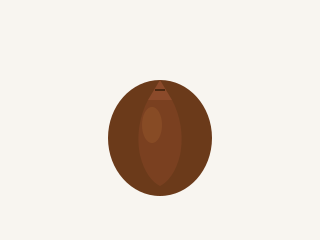
Nuts
Chestnut
Chestnuts are the sweet, starchy nuts of Castanea trees—European, Asian, and once-dominant American species—closer in the pan to a floury vegetable than to oily almonds or walnuts. Raw, they are firm and astringent under a tough shell and bitter inner skin; cooked, they turn soft, honeyed, and crumbly-moist, which is why mountain kitchens treated them as winter carbohydrate long before they became a holiday roast novelty. Getting a good chestnut onto the plate means scoring the shell so steam can escape, then roasting or boiling until the flesh yields, and peeling both the outer shell and the thin tan skin while everything is still warm. Fresh nuts behave like produce: they mould or dry out within days if left in a warm bowl. Dried nuts, vacuum kernels, flour, and sweetened puree are the forms that travel. A good chestnut smells clean and sweet when cracked; a bad one rattles hollow, shows mould at the eye, or tastes flat and cardboard once cooked. Choose heavy, glossy shells for roasting; for baking projects, prefer peeled vacuum packs or flour from a recent mill date rather than a dusty open bin.
Track this ingredient
Cuts & parts

Breeds & varieties
A sample of named types with their own origin and culinary profiles. Showing 10 of 18.


Characteristics
Preparations
Provenance
Sources
Traits
Nutrition and pairings
Nutrition
Typical values per 100 g edible portion. Nutrient names open the reference page.
Nutrition Facts
Per 100 g edible portion
Amount per 100 g
- Total Fat 11.6 g
- Saturated Fat 1.62 g
- Trans Fat 0 g
- Monounsaturated Fat 6.89 g
- Polyunsaturated Fat 3.08 g
- Cholesterol 0 mg
- Sodium 4.86 mg
- Salt 0.01 g
- Total Carbohydrate 50.5 g
- Dietary Fibre 7.39 g
- Total Sugars 3.98 g
- Complex / starch 15.3 g
- Protein 27.2 g
- Water 5.75 g
- Energy 415 kcal
- Water 5.75 g
- Carbohydrates 50.5 g
- Sugars 3.98 g
- Monosaccharides 2.78 g
- Disaccharides 1.2 g
- Starch 15.3 g
- Amylose 3.81 g
- Amylopectin 11.4 g
- Digestible Starch 13 g
- Resistant Starch 1.53 g
- Fibre 7.39 g
- Soluble Fibre 2.59 g
- Insoluble Fibre 4.8 g
- Protein 27.2 g
- Plant Protein 18.2 g
- Fat 11.6 g
- Saturated Fat 1.62 g
- Monounsaturated Fat 6.89 g
- Polyunsaturated Fat 3.08 g
- Vitamins 84.2 mg
- Vitamin A 20 µg
- Vitamin B1 — Thiamine 0.19 mg
- Vitamin B2 — Riboflavin 0.14 mg
- Vitamin B3 — Niacin 1.91 mg
- Vitamin B5 — Pantothenic Acid 0.47 mg
- Vitamin B6 0.14 mg
- Vitamin B7 — Biotin 13.9 µg
- Vitamin B9 — Folate 36.6 µg
- Vitamin C 2 mg
- Vitamin E 4.48 mg
- Vitamin K 4.4 µg
- Minerals 218 mg
- Major Minerals 209 mg
- Trace Minerals 8.9 mg
- Salt 0.01 g
- Sodium Chloride 0.01 g
Vitamins
vitamin-c: 2 · vitamin-a: 20 · vitamin-b1-thiamine: 0.19 · vitamin-b2-riboflavin: 0.14 · vitamin-b3-niacin: 1.91 · vitamin-b5-pantothenic-acid: 0.47 · vitamin-b6: 0.14 · vitamin-b7-biotin: 13.9 · vitamin-b9-folate: 36.6 · vitamin-e: 4.48 · vitamin-k: 4.4 ·
Minerals
Sodium: 4.86 · Potassium: 162 · Calcium: 42 · Iron: 0.7 · Zinc: 3.2 · Iodine: 5 ·
Chestnuts are the starchy outlier among nuts—far less oil, more carbohydrate.
History
Mountain and Mediterranean communities relied on chestnut forests as a staple carbohydrate where grain was scarce.
Italian and wider European upland economies organised life around chestnut harvest, drying, and flour.
Chestnut blight destroyed mature American chestnut canopies, collapsing a major eastern mast resource.
Holiday roasting, gluten-free chestnut flour, and French-style purees kept chestnuts in global specialty trade.