
Nuts
Whole
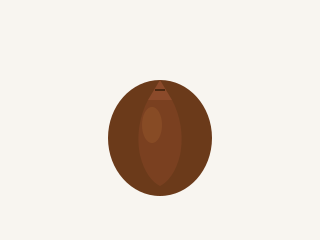
Whole chestnuts mean the nut as harvested and sold intact—usually still in the hard shell for market stalls and autumn displays, sometimes as whole peeled cooked meats for convenience. Buying whole in-shell fruit is how most people meet chestnuts for the first time: you score, roast, peel, and eat while warm. Whole peeled cooked chestnuts in jars or vacuum packs skip the struggle and go straight into stuffing, braises, and desserts. A good whole in-shell chestnut feels heavy for its size and has a tight shell; a good whole peeled kernel is intact, moist, and evenly coloured. A bad whole nut is lightweight, rattling, or smells fermented when cracked. Store in-shell nuts cool like apples; once peeled and cooked, refrigerate and finish within a few days unless frozen.
Track this ingredient
Cuts & parts
Characteristics
Preparations
Traits
Nutrition and pairings
Nutrition
Typical values per 100 g edible portion. Nutrient names open the reference page.
Nutrition Facts
Per 100 g edible portion
Amount per 100 g
- Total Fat 11.1 g
- Saturated Fat 1.57 g
- Trans Fat 0 g
- Monounsaturated Fat 6.45 g
- Polyunsaturated Fat 3.11 g
- Cholesterol 0 mg
- Sodium 4.91 mg
- Salt 0.01 g
- Total Carbohydrate 51.2 g
- Dietary Fibre 7.55 g
- Total Sugars 3.99 g
- Complex / starch 15.3 g
- Protein 25.7 g
- Water 5.94 g
- Energy 408 kcal
- Water 5.94 g
- Carbohydrates 51.2 g
- Protein 25.7 g
- Fat 11.1 g
- Saturated Fat 1.57 g
- Monounsaturated Fat 6.45 g
- Polyunsaturated Fat 3.11 g
- Omega-3 0.47 g
- Vitamins 81.4 mg
- Vitamin A 15 µg
- Vitamin B1 — Thiamine 0.2 mg
- Vitamin B2 — Riboflavin 0.15 mg
- Vitamin B3 — Niacin 1.97 mg
- Vitamin B5 — Pantothenic Acid 0.49 mg
- Vitamin B6 0.14 mg
- Vitamin B7 — Biotin 14.3 µg
- Vitamin B9 — Folate 37.9 µg
- Vitamin C 2 mg
- Vitamin E 4.63 mg
- Vitamin K 4.6 µg
- Minerals 354 mg
- Major Minerals 353 mg
- Trace Minerals 1.5 mg
- Iron 1.5 mg
- Salt 0.01 g
Vitamins
vitamin-c: 2 · vitamin-a: 15 · vitamin-b1-thiamine: 0.2 · vitamin-b2-riboflavin: 0.15 · vitamin-b3-niacin: 1.97 · vitamin-b5-pantothenic-acid: 0.49 · vitamin-b6: 0.14 · vitamin-b7-biotin: 14.3 · vitamin-b9-folate: 37.9 · vitamin-e: 4.63 · vitamin-k: 4.6 ·
Minerals
Whole form averages edible parts as typically consumed.
History
Whole in-shell chestnuts were the standard market form across European harvest seasons.
Whole peeled cooked chestnuts entered jars and tins for urban home cooks.
Vacuum whole kernels expanded ready-to-use chestnut cooking worldwide.