
Nuts
Shell
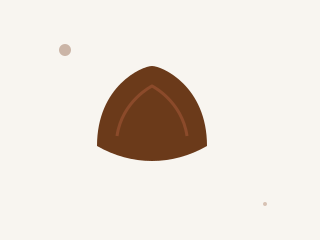
The chestnut shell is the hard, glossy outer armour of the nut—shiny brown when healthy, pointed toward the style end, with a pale scar at the base. It is not eaten. Its job in the kitchen is protection during storage and roasting, and it must be scored before high heat so steam does not explode the nut open messily. Once the kernel is cooked, the shell is cracked and discarded along with the thin inner skin that clings to the meat. A good in-shell lot shows tight, uncracked shells without holes or mould fuzz. A bad lot is light, dull, or pinholed by insects. Shells have little culinary afterlife beyond compost; do not grind them into flour. When recipes speak of “chestnuts,” they mean the kernel inside, not this woody case.
Track this ingredient
Characteristics
Preparations
Traits
Nutrition and pairings
Nutrition
Typical values per 100 g edible portion. Nutrient names open the reference page.
Nutrition Facts
Per 100 g edible portion
Amount per 100 g
- Total Fat 0.4 g
- Saturated Fat 0.08 g
- Trans Fat 0 g
- Monounsaturated Fat 0.16 g
- Polyunsaturated Fat 0.16 g
- Cholesterol 0 mg
- Sodium 5.15 mg
- Salt 0.01 g
- Total Carbohydrate 80.1 g
- Dietary Fibre 55 g
- Total Sugars 3 g
- Complex / starch 8 g
- Protein 3.5 g
- Water 12 g
- Energy 338 kcal
- Water 12 g
- Carbohydrates 80.1 g
- Protein 3.5 g
- Fat 0.4 g
- Saturated Fat 0.08 g
- Monounsaturated Fat 0.16 g
- Polyunsaturated Fat 0.16 g
- Omega-3 0.01 g
- Vitamins 75.8 mg
- Vitamin A 15 µg
- Vitamin B1 — Thiamine 0.18 mg
- Vitamin B2 — Riboflavin 0.14 mg
- Vitamin B3 — Niacin 1.81 mg
- Vitamin B5 — Pantothenic Acid 0.45 mg
- Vitamin B6 0.13 mg
- Vitamin B7 — Biotin 13.1 µg
- Vitamin B9 — Folate 34.6 µg
- Vitamin C 2 mg
- Vitamin E 4.23 mg
- Vitamin K 4.2 µg
- Minerals 331 mg
- Major Minerals 329 mg
- Trace Minerals 1.5 mg
- Iron 1.5 mg
- Salt 0.01 g
Vitamins
vitamin-c: 2 · vitamin-a: 15 · vitamin-b1-thiamine: 0.18 · vitamin-b2-riboflavin: 0.14 · vitamin-b3-niacin: 1.81 · vitamin-b5-pantothenic-acid: 0.45 · vitamin-b6: 0.13 · vitamin-b7-biotin: 13.1 · vitamin-b9-folate: 34.6 · vitamin-e: 4.23 · vitamin-k: 4.2 ·
Minerals
Shell is largely mineral; edible value is minimal except as calcium source when finely prepared.
History
Hard shells allowed chestnuts to be stored and transported as winter reserves.
Market grading of in-shell chestnuts used shell integrity as a freshness cue.
Consumers still judge holiday roasting nuts by heavy, glossy shells.