
Fruit
Asian Pear
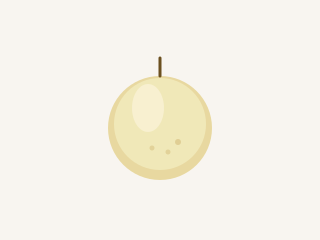
Asian pear (nashi, Pyrus pyrifolia and related) is a round or oval pear with crisp, juicy, apple-like texture rather than the buttery melt of many European pears. Skin may be russet-brown or yellow-green; flavour is mild, sweet, and refreshing with light floral notes. Fruit is usually eaten raw and chilled, peeled or not. Excellent in salads, slaws, and cheese boards; also juiced, poached lightly, or dried. Unlike soft European pears, many Asian pears stay crisp when ripe and store well refrigerated. Japan, Korea, and China are historic centres; orchards now exist in California, Australia, and elsewhere.
Track this ingredient
Cuts & parts

Breeds & varieties
A sample of named types with their own origin and culinary profiles.


Characteristics
Preparations
Provenance
Sources
Traits
Nutrition and pairings
Nutrition
Typical values per 100 g edible portion. Nutrient names open the reference page.
Nutrition Facts
Per 100 g edible portion
Amount per 100 g
- Total Fat 0.3 g
- Saturated Fat 0.05 g
- Trans Fat 0 g
- Monounsaturated Fat 0.1 g
- Polyunsaturated Fat 0.09 g
- Cholesterol 0 mg
- Sodium 4.6 mg
- Salt 0.01 g
- Total Carbohydrate 13 g
- Dietary Fibre 1.94 g
- Total Sugars 10.4 g
- Complex / starch 1.02 g
- Protein 0.81 g
- Water 89.1 g
- Energy 56.4 kcal
- Water 89.1 g
- Carbohydrates 13 g
- Sugars 10.4 g
- Monosaccharides 7.3 g
- Disaccharides 3.13 g
- Starch 1.02 g
- Amylose 0.26 g
- Amylopectin 0.77 g
- Digestible Starch 0.87 g
- Resistant Starch 0.1 g
- Fibre 1.94 g
- Soluble Fibre 0.68 g
- Insoluble Fibre 1.26 g
- Protein 0.81 g
- Plant Protein 0.77 g
- Fat 0.3 g
- Saturated Fat 0.05 g
- Monounsaturated Fat 0.1 g
- Polyunsaturated Fat 0.09 g
- Vitamins 79.6 mg
- Vitamin A 20 µg
- Vitamin B1 — Thiamine 0.03 mg
- Vitamin B2 — Riboflavin 0.04 mg
- Vitamin B3 — Niacin 0.37 mg
- Vitamin B5 — Pantothenic Acid 0.19 mg
- Vitamin B6 0.07 mg
- Vitamin B7 — Biotin 0.9 µg
- Vitamin B9 — Folate 13.4 µg
- Vitamin C 40 mg
- Vitamin E 0.26 mg
- Vitamin K 4.3 µg
- Minerals 341 mg
- Major Minerals 335 mg
- Trace Minerals 6.4 mg
- Salt 0.01 g
- Sodium Chloride 0.01 g
Vitamins
vitamin-c: 40 · vitamin-a: 20 · vitamin-b1-thiamine: 0.03 · vitamin-b2-riboflavin: 0.04 · vitamin-b3-niacin: 0.37 · vitamin-b5-pantothenic-acid: 0.19 · vitamin-b6: 0.07 · vitamin-b7-biotin: 0.9 · vitamin-b9-folate: 13.4 · vitamin-e: 0.26 · vitamin-k: 4.3 ·
Minerals
Sodium: 4.6 · Potassium: 275 · Calcium: 55 · Iron: 1 · Zinc: 0.4 · Iodine: 5 ·
Fruit energy is mostly natural sugars with fibre and vitamin C varying by species.
History
East Asian cultivation of crisp pears developed distinct from western European pear types.
Japanese nashi orcharding refined named cultivars for fresh eating.
Asian pears entered Western specialty orchards and markets.
Export and supermarket programmes made nashi a familiar fresh fruit outside East Asia.