
Beverage
Coffee
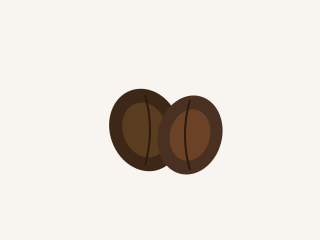
Coffee is the roasted seed of Coffea—mostly arabica for the cup, robusta when you want crema, cheap caffeine, or a rubbery punch. Origin, process (washed, natural, honey), and roast decide whether the brew tastes of citrus and florals or of smoke and cocoa. It is a drink first and a kitchen flavour second: espresso in a ragù, cold brew in a brine, grounds in a dry rub, instant in a chocolate cake when you need bitterness without liquid. Brew it for the method you have—espresso, filter, ibrik, instant—and do not treat them as interchangeable in a recipe. Stale supermarket grounds will season a marinade; they will not make a good cup. Distinct from chicory, from cocoa, and from coffee extract sold as a baking bottle.
Also known as: Buna
Track this ingredient
Cuts & parts
Breeds & varieties
A sample of named types with their own origin and culinary profiles. Showing 10 of 60.


Characteristics
Preparations
Provenance
Sources
Traits
Nutrition and pairings
Nutrition
Typical values per 100 g edible portion. Nutrient names open the reference page.
Nutrition Facts
Per 100 g edible portion
Amount per 100 g
- Total Fat 0.1 g
- Saturated Fat 0 g
- Trans Fat 0 g
- Monounsaturated Fat 0 g
- Polyunsaturated Fat 0 g
- Cholesterol 0 mg
- Sodium 4.75 mg
- Salt 0.01 g
- Total Carbohydrate 8.68 g
- Dietary Fibre 0 g
- Total Sugars 7.82 g
- Complex / starch 0 g
- Protein 0.47 g
- Water 89.7 g
- Energy 37.5 kcal
- Water 89.7 g
- Carbohydrates 8.68 g
- Sugars 7.82 g
- Monosaccharides 5.48 g
- Disaccharides 2.35 g
- Protein 0.47 g
- Fat 0.1 g
- Vitamins 25 mg
- Vitamin A 20 µg
- Vitamin B1 — Thiamine 0.02 mg
- Vitamin B2 — Riboflavin 0.04 mg
- Vitamin B3 — Niacin 0.44 mg
- Vitamin B5 — Pantothenic Acid 0.09 mg
- Vitamin B6 0.02 mg
- Vitamin B7 — Biotin 0.4 µg
- Vitamin B9 — Folate 1.7 µg
- Vitamin C 2 mg
- Vitamin E 0.06 mg
- Vitamin K 0.2 µg
- Minerals 291 mg
- Major Minerals 285 mg
- Trace Minerals 5.9 mg
- Salt 0.01 g
- Sodium Chloride 0.01 g
- Bioactive Compounds 60 mg
- Caffeine 60 mg
Vitamins
vitamin-c: 2 · vitamin-a: 20 · vitamin-b1-thiamine: 0.02 · vitamin-b2-riboflavin: 0.04 · vitamin-b3-niacin: 0.44 · vitamin-b5-pantothenic-acid: 0.09 · vitamin-b6: 0.02 · vitamin-b7-biotin: 0.4 · vitamin-b9-folate: 1.7 · vitamin-e: 0.06 · vitamin-k: 0.2 ·
Minerals
Sodium: 4.75 · Potassium: 230 · Calcium: 50 · Iron: 0.5 · Zinc: 0.4 · Iodine: 5 ·
Beverage bases range from near-water teas to sugar-dense cordials; alcohol adds energy when present.
Grading systems
Grades are placed along a shared scale so systems can be compared side by side.
History
Coffee drinking traditions emerged in Ethiopia before spreading through the Arabian Peninsula.
Ottoman coffee houses and trade carried coffee culture into Europe and beyond.
Colonial plantations in the Americas and Asia industrialised global coffee supply.
Espresso machines, instant coffee, and specialty origin grading transformed everyday coffee habits.