
Fruit
Cherry
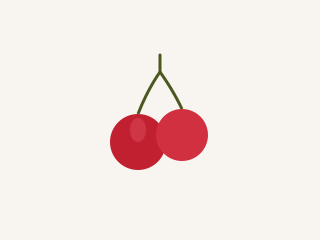
Cherry fruit comes mainly from sweet (Prunus avium) and sour/tart (Prunus cerasus) species. Sweet cherries are eaten fresh—juicy, firm, and honeyed when ripe; sour cherries cook into pies, preserves, sauces, and drinks with bright acidity. Pit for baking and sauces; leave stems on for fresh display. Pair with almond, dark chocolate, duck, and wine reductions. Season is short; frozen and jarred sour cherries extend pie season.
Track this ingredient
Cuts & parts

Breeds & varieties
A sample of named types with their own origin and culinary profiles. Showing 10 of 12.


Characteristics
Preparations
Provenance
Sources
Traits
Nutrition and pairings
Nutrition
Typical values per 100 g edible portion. Nutrient names open the reference page.
Nutrition Facts
Per 100 g edible portion
Amount per 100 g
- Total Fat 0.31 g
- Saturated Fat 0.05 g
- Trans Fat 0 g
- Monounsaturated Fat 0.11 g
- Polyunsaturated Fat 0.1 g
- Cholesterol 0 mg
- Sodium 4.8 mg
- Salt 0.01 g
- Total Carbohydrate 13.4 g
- Dietary Fibre 1.97 g
- Total Sugars 10.5 g
- Complex / starch 1.06 g
- Protein 0.84 g
- Water 90.1 g
- Energy 57.8 kcal
- Water 90.1 g
- Carbohydrates 13.4 g
- Sugars 10.5 g
- Monosaccharides 7.38 g
- Disaccharides 3.17 g
- Starch 1.06 g
- Amylose 0.27 g
- Amylopectin 0.8 g
- Digestible Starch 0.9 g
- Resistant Starch 0.11 g
- Fibre 1.97 g
- Soluble Fibre 0.69 g
- Insoluble Fibre 1.28 g
- Protein 0.84 g
- Plant Protein 0.8 g
- Fat 0.31 g
- Saturated Fat 0.05 g
- Monounsaturated Fat 0.11 g
- Polyunsaturated Fat 0.1 g
- Vitamins 81.8 mg
- Vitamin A 20 µg
- Vitamin B1 — Thiamine 0.03 mg
- Vitamin B2 — Riboflavin 0.05 mg
- Vitamin B3 — Niacin 0.45 mg
- Vitamin B5 — Pantothenic Acid 0.22 mg
- Vitamin B6 0.09 mg
- Vitamin B7 — Biotin 1.1 µg
- Vitamin B9 — Folate 16.2 µg
- Vitamin C 38 mg
- Vitamin E 0.32 mg
- Vitamin K 5.3 µg
- Minerals 377 mg
- Major Minerals 371 mg
- Trace Minerals 6.2 mg
- Salt 0.01 g
- Sodium Chloride 0.01 g
Vitamins
vitamin-c: 38 · vitamin-a: 20 · vitamin-b1-thiamine: 0.03 · vitamin-b2-riboflavin: 0.05 · vitamin-b3-niacin: 0.45 · vitamin-b5-pantothenic-acid: 0.22 · vitamin-b6: 0.09 · vitamin-b7-biotin: 1.1 · vitamin-b9-folate: 16.2 · vitamin-e: 0.32 · vitamin-k: 5.3 ·
Minerals
Sodium: 4.8 · Potassium: 313 · Calcium: 53 · Iron: 0.8 · Zinc: 0.4 · Iodine: 5 ·
Fruit energy is mostly natural sugars with fibre and vitamin C varying by species.
Grading systems
Grades are placed along a shared scale so systems can be compared side by side.
History
Wild cherries were gathered across temperate Eurasia long before orchard culture.
Greek and Roman writers linked fine cherries to regions of Asia Minor.
European orchardists spread sweet and sour cultivars through temperate colonies.
Michigan, the Pacific Northwest, and similar regions built large cherry industries.