
Herb
Bay
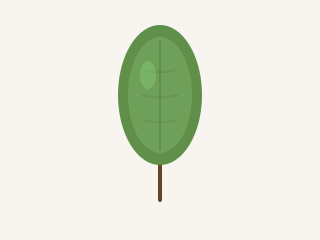
Bay is the aromatic leaf of the bay laurel tree (Laurus nobilis), used whole in stocks, stews, braises, pickles, and rice dishes. Fresh leaves are greener and slightly more floral; dried bay is the global pantry standard and releases flavour slowly during cooking. Leaves are typically removed before serving. California bay and other lookalikes differ in strength and chemistry, so true Mediterranean laurel is preferred for classic European recipes.
Also known as: Dáfni, Alloro, Laurier, Tej Patta
Track this ingredient
Cuts & parts

Breeds & varieties
A sample of named types with their own origin and culinary profiles. Showing 10 of 16.


Characteristics
Preparations
Provenance
Sources
Traits
Nutrition and pairings
Nutrition
Typical values per 100 g edible portion. Nutrient names open the reference page.
Nutrition Facts
Per 100 g edible portion
Amount per 100 g
- Total Fat 0.75 g
- Saturated Fat 0.2 g
- Trans Fat 0 g
- Monounsaturated Fat 0.1 g
- Polyunsaturated Fat 0.37 g
- Cholesterol 0 mg
- Sodium 25.3 mg
- Salt 0.05 g
- Total Carbohydrate 7.15 g
- Dietary Fibre 4.25 g
- Total Sugars 0.97 g
- Complex / starch 0.97 g
- Protein 3.07 g
- Water 84.3 g
- Energy 38.5 kcal
- Water 84.3 g
- Carbohydrates 7.15 g
- Sugars 0.97 g
- Monosaccharides 0.68 g
- Disaccharides 0.29 g
- Starch 0.97 g
- Amylose 0.24 g
- Amylopectin 0.73 g
- Digestible Starch 0.82 g
- Resistant Starch 0.1 g
- Fibre 4.25 g
- Soluble Fibre 1.49 g
- Insoluble Fibre 2.76 g
- Protein 3.07 g
- Plant Protein 2.92 g
- Fat 0.75 g
- Saturated Fat 0.2 g
- Monounsaturated Fat 0.1 g
- Polyunsaturated Fat 0.37 g
- Vitamins 381 mg
- Vitamin A 20 µg
- Vitamin B1 — Thiamine 0.08 mg
- Vitamin B2 — Riboflavin 0.15 mg
- Vitamin B3 — Niacin 0.99 mg
- Vitamin B5 — Pantothenic Acid 0.39 mg
- Vitamin B6 0.19 mg
- Vitamin B7 — Biotin 1.9 µg
- Vitamin B9 — Folate 76.2 µg
- Vitamin C 2 mg
- Vitamin E 1.87 mg
- Vitamin K 277 µg
- Minerals 244 mg
- Major Minerals 237 mg
- Trace Minerals 6.5 mg
- Salt 0.05 g
- Sodium Chloride 0.05 g
Vitamins
vitamin-c: 2 · vitamin-a: 20 · vitamin-b1-thiamine: 0.08 · vitamin-b2-riboflavin: 0.15 · vitamin-b3-niacin: 0.99 · vitamin-b5-pantothenic-acid: 0.39 · vitamin-b6: 0.19 · vitamin-b7-biotin: 1.9 · vitamin-b9-folate: 76.2 · vitamin-e: 1.87 · vitamin-k: 276.9 ·
Minerals
Sodium: 25.29 · Potassium: 156 · Calcium: 56 · Iron: 1.1 · Zinc: 0.4 · Iodine: 5 ·
Fresh herbs are aromatic leaves—modest macros, concentrated micronutrients and polyphenols per gram dry.
History
Bay laurel was sacred in Greek culture and used in Mediterranean cookery and garlands.
Roman cookery texts recorded bay leaf in sauces, wines, and preserved foods.
Bay trees and dried leaves spread with European trade into colonial kitchens worldwide.
Packaged dried bay leaves became a universal slow-cooking aromatic in retail spice aisles.