
Fruit
Strawberry
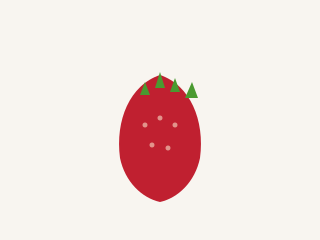
Strawberry is the aggregate fruit of Fragaria × ananassa and related species—bright red when ripe, intensely aromatic, and soft enough to crush between the fingers. True flavour is a balance of sugar, acid, and volatile esters; pale underripe berries taste hollow and grassy, while overripe fruit collapses into jammy mush. Commercial breeding favoured firm shipping types, so local soft berries often out-flavour supermarket stock. Hull (calyx) is pulled or cut before eating; the surface seeds are achenes, not true pits. Eaten out of hand, sliced over cream or yoghurt, baked into shortcakes and tarts, or cooked quickly into jam and coulis. Heat dulls the perfume, so many desserts keep berries raw or barely warm. Freeze whole on trays for smoothies; macerate with sugar and a splash of balsamic or black pepper for savoury salads. Spain, California, Mexico, and the Low Countries dominate export windows; heritage alpine and wood strawberries supply tiny, highly scented fruit for pastry work.
Track this ingredient
Cuts & parts
Breeds & varieties
A sample of named types with their own origin and culinary profiles.


Characteristics
Preparations
Provenance
Sources
Traits
Nutrition and pairings
Nutrition
Typical values per 100 g edible portion. Nutrient names open the reference page.
Nutrition Facts
Per 100 g edible portion
Amount per 100 g
- Total Fat 0.28 g
- Saturated Fat 0.05 g
- Trans Fat 0 g
- Monounsaturated Fat 0.11 g
- Polyunsaturated Fat 0.1 g
- Cholesterol 0 mg
- Sodium 4.83 mg
- Salt 0.01 g
- Total Carbohydrate 13.4 g
- Dietary Fibre 1.91 g
- Total Sugars 10.2 g
- Complex / starch 0.96 g
- Protein 0.8 g
- Water 87.6 g
- Energy 56.6 kcal
- Water 87.6 g
- Carbohydrates 13.4 g
- Sugars 10.2 g
- Monosaccharides 7.16 g
- Disaccharides 3.07 g
- Starch 0.96 g
- Amylose 0.24 g
- Amylopectin 0.72 g
- Digestible Starch 0.82 g
- Resistant Starch 0.1 g
- Fibre 1.91 g
- Soluble Fibre 0.67 g
- Insoluble Fibre 1.24 g
- Protein 0.8 g
- Plant Protein 0.76 g
- Fat 0.28 g
- Saturated Fat 0.05 g
- Monounsaturated Fat 0.11 g
- Polyunsaturated Fat 0.1 g
- Vitamins 76.7 mg
- Vitamin A 20 µg
- Vitamin B1 — Thiamine 0.03 mg
- Vitamin B2 — Riboflavin 0.04 mg
- Vitamin B3 — Niacin 0.36 mg
- Vitamin B5 — Pantothenic Acid 0.18 mg
- Vitamin B6 0.07 mg
- Vitamin B7 — Biotin 0.9 µg
- Vitamin B9 — Folate 12.8 µg
- Vitamin C 38 mg
- Vitamin E 0.25 mg
- Vitamin K 4.1 µg
- Minerals 457 mg
- Major Minerals 451 mg
- Trace Minerals 6.2 mg
- Salt 0.01 g
- Sodium Chloride 0.01 g
Vitamins
vitamin-c: 38 · vitamin-a: 20 · vitamin-b1-thiamine: 0.03 · vitamin-b2-riboflavin: 0.04 · vitamin-b3-niacin: 0.36 · vitamin-b5-pantothenic-acid: 0.18 · vitamin-b6: 0.07 · vitamin-b7-biotin: 0.9 · vitamin-b9-folate: 12.8 · vitamin-e: 0.25 · vitamin-k: 4.1 ·
Minerals
Sodium: 4.83 · Potassium: 393 · Calcium: 53 · Iron: 0.8 · Zinc: 0.4 · Iodine: 5 ·
Fruit energy is mostly natural sugars with fibre and vitamin C varying by species.
Grading systems
Grades are placed along a shared scale so systems can be compared side by side.
History
Strawberry was used as a fruit food in regional diets long before industrial packing and global year-round supply.
Trade, migration, and selection spread distinctive Strawberry types and preparations into new climates and cuisines.
Modern production, storage, and transport made Strawberry a regular purchase far from where it is grown or raised.
Cooks now treat Strawberry as both staple and specialty, with more attention to provenance, variety, and form.