
Fruit
Watermelon
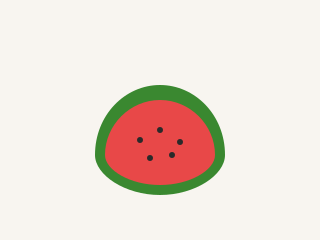
Watermelon (Citrullus lanatus) is a large trailing cucurbit grown for watery, sugar-rich flesh—classically deep red, also yellow, orange, and white—inside a thick green rind. Seeded types carry flat black or brown seeds; seedless triploids dominate many markets. Ripeness shows as a creamy ground spot, dry tendril near the stem, and a deep hollow thump; pale underripe flesh tastes bland and firm. Eaten chilled in wedges, cubed for salads with feta and mint, blended into agua fresca, or grilled briefly for smoky sweetness. Rind pickles in Southern US and Asian traditions; seeds roast as snacks in many cultures. China leads production; seasonal local melons often outclass long-hauled fruit. Once cut, keep cold and use within a few days as surface softens and ferments.
Track this ingredient
Cuts & parts

Breeds & varieties
A sample of named types with their own origin and culinary profiles.


Characteristics
Preparations
Provenance
Sources
Traits
Nutrition and pairings
Nutrition
Typical values per 100 g edible portion. Nutrient names open the reference page.
Nutrition Facts
Per 100 g edible portion
Amount per 100 g
- Total Fat 0.28 g
- Saturated Fat 0.05 g
- Trans Fat 0 g
- Monounsaturated Fat 0.1 g
- Polyunsaturated Fat 0.09 g
- Cholesterol 0 mg
- Sodium 4.77 mg
- Salt 0.01 g
- Total Carbohydrate 13.5 g
- Dietary Fibre 1.94 g
- Total Sugars 10.4 g
- Complex / starch 1 g
- Protein 0.76 g
- Water 88.9 g
- Energy 54.6 kcal
- Water 88.9 g
- Carbohydrates 13.5 g
- Sugars 10.4 g
- Monosaccharides 7.28 g
- Disaccharides 3.12 g
- Starch 1 g
- Amylose 0.25 g
- Amylopectin 0.75 g
- Digestible Starch 0.85 g
- Resistant Starch 0.1 g
- Fibre 1.94 g
- Soluble Fibre 0.68 g
- Insoluble Fibre 1.26 g
- Protein 0.76 g
- Plant Protein 0.72 g
- Fat 0.28 g
- Saturated Fat 0.05 g
- Monounsaturated Fat 0.1 g
- Polyunsaturated Fat 0.09 g
- Vitamins 94.9 mg
- Vitamin A 20 µg
- Vitamin B1 — Thiamine 0.03 mg
- Vitamin B2 — Riboflavin 0.05 mg
- Vitamin B3 — Niacin 0.45 mg
- Vitamin B5 — Pantothenic Acid 0.22 mg
- Vitamin B6 0.09 mg
- Vitamin B7 — Biotin 1.1 µg
- Vitamin B9 — Folate 16.3 µg
- Vitamin C 51 mg
- Vitamin E 0.32 mg
- Vitamin K 5.3 µg
- Minerals 483 mg
- Major Minerals 477 mg
- Trace Minerals 6.5 mg
- Salt 0.01 g
- Sodium Chloride 0.01 g
Vitamins
vitamin-c: 51 · vitamin-a: 20 · vitamin-b1-thiamine: 0.03 · vitamin-b2-riboflavin: 0.05 · vitamin-b3-niacin: 0.45 · vitamin-b5-pantothenic-acid: 0.22 · vitamin-b6: 0.09 · vitamin-b7-biotin: 1.1 · vitamin-b9-folate: 16.3 · vitamin-e: 0.32 · vitamin-k: 5.3 ·
Minerals
Sodium: 4.77 · Potassium: 406 · Calcium: 66 · Iron: 1.1 · Zinc: 0.4 · Iodine: 5 ·
Fruit energy is mostly natural sugars with fibre and vitamin C varying by species.
Grading systems
Grades are placed along a shared scale so systems can be compared side by side.
History
Watermelon was used as a fruit food in regional diets long before industrial packing and global year-round supply.
Trade, migration, and selection spread distinctive Watermelon types and preparations into new climates and cuisines.
Modern production, storage, and transport made Watermelon a regular purchase far from where it is grown or raised.
Cooks now treat Watermelon as both staple and specialty, with more attention to provenance, variety, and form.