
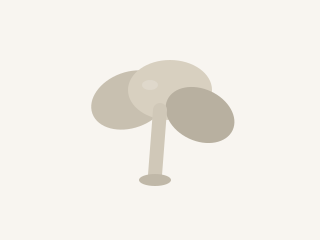
Funghi
Oyster Mushroom
Oyster mushroom (Pleurotus spp.) grows in shelf-like clusters with soft caps and short stems, ranging from grey and white to pink, yellow, and blue specialty types. Flavour is mild, slightly anise-sweet, and takes browning well in high-heat cooking. King oyster (Pleurotus eryngii) is a thicker, meatier relative treated here as a variety: long stems sear like scallops while caps remain tender. Cultivated on agricultural waste substrates worldwide.
Also known as: Ping gu, Hiratake / Eryngii, Neutari, Orecchione / Cardoncello
Track this ingredient
Cuts & parts
Breeds & varieties
A sample of named types with their own origin and culinary profiles. Showing 10 of 18.


Characteristics
Preparations
Provenance
Sources
Traits
Nutrition and pairings
Nutrition
Typical values per 100 g edible portion. Nutrient names open the reference page.
Nutrition Facts
Per 100 g edible portion
Amount per 100 g
- Total Fat 0.41 g
- Saturated Fat 0.09 g
- Trans Fat 0 g
- Monounsaturated Fat 0 g
- Polyunsaturated Fat 0.2 g
- Cholesterol 0 mg
- Sodium 9.23 mg
- Salt 0.05 g
- Total Carbohydrate 3.83 g
- Dietary Fibre 1.96 g
- Total Sugars 1.6 g
- Complex / starch 0.48 g
- Protein 2.83 g
- Water 95.6 g
- Energy 30.8 kcal
- Water 95.6 g
- Carbohydrates 3.83 g
- Sugars 1.6 g
- Monosaccharides 1.12 g
- Disaccharides 0.48 g
- Starch 0.48 g
- Amylose 0.12 g
- Amylopectin 0.36 g
- Digestible Starch 0.41 g
- Resistant Starch 0.05 g
- Fibre 1.96 g
- Soluble Fibre 0.69 g
- Insoluble Fibre 1.27 g
- Protein 2.83 g
- Fungal Protein 2.69 g
- Fat 0.41 g
- Saturated Fat 0.09 g
- Polyunsaturated Fat 0.2 g
- Vitamins 54.7 mg
- Vitamin A 20 µg
- Vitamin B1 — Thiamine 0.07 mg
- Vitamin B2 — Riboflavin 0.36 mg
- Vitamin B3 — Niacin 3.56 mg
- Vitamin B5 — Pantothenic Acid 1.32 mg
- Vitamin B6 0.09 mg
- Vitamin B7 — Biotin 6.9 µg
- Vitamin B9 — Folate 17 µg
- Vitamin C 2 mg
- Vitamin D 2.5 µg
- Vitamin E 0.08 mg
- Vitamin K 0.8 µg
- Minerals 270 mg
- Major Minerals 263 mg
- Trace Minerals 6.6 mg
- Salt 0.05 g
- Sodium Chloride 0.05 g
Vitamins
vitamin-c: 2 · vitamin-a: 20 · vitamin-b1-thiamine: 0.07 · vitamin-b2-riboflavin: 0.36 · vitamin-b3-niacin: 3.56 · vitamin-b5-pantothenic-acid: 1.32 · vitamin-b6: 0.09 · vitamin-b7-biotin: 6.9 · vitamin-b9-folate: 17 · vitamin-d: 2.5 · vitamin-e: 0.08 · vitamin-k: 0.8 ·
Minerals
Sodium: 9.23 · Potassium: 187 · Calcium: 67 · Iron: 1.2 · Zinc: 0.4 · Iodine: 5 ·
Mushrooms are high-water fungal tissue with modest protein and distinctive beta-glucans.
In the kitchen
Culinary partners and combinations that usually underperform with Oyster Mushroom.
Usually avoid with
Often clash in flavour or tradition
History
Wild Pleurotus species were foraged across temperate forests in Europe and Asia.
German wartime research advanced oyster mushroom cultivation on wood substrates.
Commercial oyster farming expanded globally on straw and sawdust blocks.
Specialty colours and king oyster stems became mainstream restaurant and retail fungi.