
Fruit
Feijoa
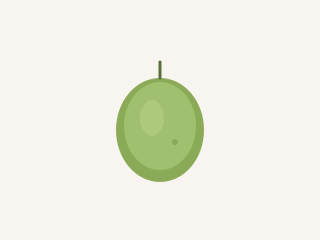
Feijoa (Acca sellowiana, pineapple guava) is an oval green fruit with granular, aromatic flesh that tastes of pineapple, guava, and minty perfume when ripe. The soft inner pulp is scooped from a slightly tart skin that some eat and others discard. Fruit drops when ripe; tree-ripened flavour beats hard, underripe imports. New Zealand, southern Australia, and parts of South America and the Mediterranean grow it for fresh eating, chutneys, crumbles, and cordials. Halve and spoon like a kiwifruit, or scoop into cakes and ice cream. Ripen at room temperature until fragrant and giving; refrigerate briefly once soft. Brown, dry centres mean the fruit is past its peak.
Track this ingredient
Cuts & parts
Breeds & varieties
A sample of named types with their own origin and culinary profiles.


Characteristics
Preparations
Provenance
Sources
Traits
Nutrition and pairings
Nutrition
Typical values per 100 g edible portion. Nutrient names open the reference page.
Nutrition Facts
Per 100 g edible portion
Amount per 100 g
- Total Fat 0.32 g
- Saturated Fat 0.05 g
- Trans Fat 0 g
- Monounsaturated Fat 0.1 g
- Polyunsaturated Fat 0.1 g
- Cholesterol 0 mg
- Sodium 4.67 mg
- Salt 0.01 g
- Total Carbohydrate 12.4 g
- Dietary Fibre 2.13 g
- Total Sugars 9.96 g
- Complex / starch 0.96 g
- Protein 0.74 g
- Water 82.1 g
- Energy 53.6 kcal
- Water 82.1 g
- Carbohydrates 12.4 g
- Sugars 9.96 g
- Monosaccharides 6.98 g
- Disaccharides 2.99 g
- Starch 0.96 g
- Amylose 0.24 g
- Amylopectin 0.72 g
- Digestible Starch 0.82 g
- Resistant Starch 0.1 g
- Fibre 2.13 g
- Soluble Fibre 0.75 g
- Insoluble Fibre 1.38 g
- Protein 0.74 g
- Plant Protein 0.7 g
- Fat 0.32 g
- Saturated Fat 0.05 g
- Monounsaturated Fat 0.1 g
- Polyunsaturated Fat 0.1 g
- Vitamins 69.8 mg
- Vitamin A 20 µg
- Vitamin B1 — Thiamine 0.03 mg
- Vitamin B2 — Riboflavin 0.04 mg
- Vitamin B3 — Niacin 0.39 mg
- Vitamin B6 0.08 mg
- Vitamin B7 — Biotin 1 µg
- Vitamin B9 — Folate 14.2 µg
- Vitamin C 29 mg
- Vitamin E 0.28 mg
- Vitamin K 4.6 µg
- Minerals 319 mg
- Major Minerals 313 mg
- Trace Minerals 6.3 mg
- Salt 0.01 g
- Sodium Chloride 0.01 g
Vitamins
vitamin-c: 29 · vitamin-a: 20 · vitamin-b1-thiamine: 0.03 · vitamin-b2-riboflavin: 0.04 · vitamin-b3-niacin: 0.39 · vitamin-b5-pantothenic-acid: 0.2 · vitamin-b6: 0.08 · vitamin-b7-biotin: 1 · vitamin-b9-folate: 14.2 · vitamin-e: 0.28 · vitamin-k: 4.6 ·
Minerals
Sodium: 4.67 · Potassium: 264 · Calcium: 44 · Iron: 0.9 · Zinc: 0.4 · Iodine: 5 ·
Fruit energy is mostly natural sugars with fibre and vitamin C varying by species.
History
Feijoa was used as a fruit food in regional diets long before industrial packing and global year-round supply.
Trade, migration, and selection spread distinctive Feijoa types and preparations into new climates and cuisines.
Modern production, storage, and transport made Feijoa a regular purchase far from where it is grown or raised.
Cooks now treat Feijoa as both staple and specialty, with more attention to provenance, variety, and form.