
Fruit
Apple
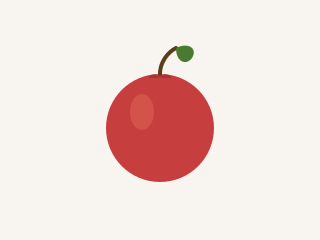
Apple is the crisp pome fruit of Malus domestica, with thousands of cultivars spanning sharp cookers, honeyed dessert types, and cider apples. Flesh is white to cream, sweet-tart in balance, with skin colours from green and yellow to deep red. Texture can be breaking-crisp or soft-mealy; pectin in many varieties sets sauces and jams without added gelatine. Eat out of hand, bake in pies and crumbles, cook to sauce, juice, ferment to cider, or dry as rings. Cooking apples such as Bramley keep structure or fluff to puree depending on heat and sugar; salad apples should stay firm. Controlled-atmosphere storage makes many dessert apples a year-round commodity from temperate orchards worldwide.
Also known as: Appelstroop
Track this ingredient
Cuts & parts
Breeds & varieties
A sample of named types with their own origin and culinary profiles. Showing 10 of 20.


Characteristics
Preparations
Provenance
Sources
Traits
Nutrition and pairings
Nutrition
Typical values per 100 g edible portion. Nutrient names open the reference page.
Nutrition Facts
Per 100 g edible portion
Amount per 100 g
- Total Fat 0.29 g
- Saturated Fat 0.05 g
- Trans Fat 0 g
- Monounsaturated Fat 0.1 g
- Polyunsaturated Fat 0.09 g
- Cholesterol 0 mg
- Sodium 5.32 mg
- Salt 0.01 g
- Total Carbohydrate 13.2 g
- Dietary Fibre 2.01 g
- Total Sugars 10.8 g
- Complex / starch 0.92 g
- Protein 0.76 g
- Water 78.7 g
- Energy 59.1 kcal
- Water 78.7 g
- Carbohydrates 13.2 g
- Sugars 10.8 g
- Monosaccharides 7.54 g
- Disaccharides 3.24 g
- Starch 0.92 g
- Amylose 0.23 g
- Amylopectin 0.69 g
- Digestible Starch 0.78 g
- Resistant Starch 0.09 g
- Fibre 2.01 g
- Soluble Fibre 0.7 g
- Insoluble Fibre 1.31 g
- Protein 0.76 g
- Plant Protein 0.72 g
- Fat 0.29 g
- Saturated Fat 0.05 g
- Monounsaturated Fat 0.1 g
- Polyunsaturated Fat 0.09 g
- Vitamins 66.7 mg
- Vitamin A 20 µg
- Vitamin B1 — Thiamine 0.03 mg
- Vitamin B2 — Riboflavin 0.04 mg
- Vitamin B3 — Niacin 0.41 mg
- Vitamin B6 0.08 mg
- Vitamin B7 — Biotin 1 µg
- Vitamin B9 — Folate 14.8 µg
- Vitamin C 25 mg
- Vitamin E 0.29 mg
- Vitamin K 4.8 µg
- Minerals 311 mg
- Major Minerals 305 mg
- Trace Minerals 5.9 mg
- Salt 0.01 g
- Sodium Chloride 0.01 g
Vitamins
vitamin-c: 25 · vitamin-a: 20 · vitamin-b1-thiamine: 0.03 · vitamin-b2-riboflavin: 0.04 · vitamin-b3-niacin: 0.41 · vitamin-b5-pantothenic-acid: 0.2 · vitamin-b6: 0.08 · vitamin-b7-biotin: 1 · vitamin-b9-folate: 14.8 · vitamin-e: 0.29 · vitamin-k: 4.8 ·
Minerals
Sodium: 5.32 · Potassium: 260 · Calcium: 40 · Iron: 0.5 · Zinc: 0.4 · Iodine: 5 ·
Fruit energy is mostly natural sugars with fibre and vitamin C varying by species.
In the kitchen
Culinary partners and combinations that usually underperform with Apple.
Usually avoid with
Often clash in flavour or tradition
Grading systems
Grades are placed along a shared scale so systems can be compared side by side.
History
Wild Malus sieversii in Central Asia is the primary ancestor of domestic apples.
Classical Mediterranean cultures cultivated and grafted named apple varieties.
British and American orcharding expanded named cookers and dessert apples, including cider culture.
Controlled-atmosphere storage and global cold chain made selected cultivars year-round retail staples.