
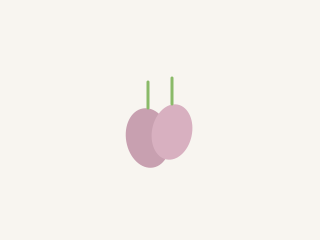
Vegetable
Shallot
Shallots are mild, clustered Allium bulbs—often Allium cepa Aggregatum group—with copper to pink skins and a flavour between onion and garlic, sweeter and less harsh when raw. French grey shallots (échalote grise) are especially prized for sauces; larger banana shallots are easier to peel for roasting and frying. Each bulb divides into cloves like garlic. Use finely diced in vinaigrettes, beurre blanc, and Asian fried shallot toppings; roast whole until jammy; pickle for charcuterie. Southeast Asian markets treat shallots as everyday aromatics. Store cool and dry; sprouting and soft spots mean age. Do not confuse with spring onions or large round onions labelled “shallot” in some regions.
Track this ingredient
Cuts & parts
Breeds & varieties
A sample of named types with their own origin and culinary profiles.


Characteristics
Preparations
Provenance
Sources
Traits
Nutrition and pairings
Nutrition
Typical values per 100 g edible portion. Nutrient names open the reference page.
Nutrition Facts
Per 100 g edible portion
Amount per 100 g
- Total Fat 0.28 g
- Saturated Fat 0.05 g
- Trans Fat 0 g
- Monounsaturated Fat 0.05 g
- Polyunsaturated Fat 0.16 g
- Cholesterol 0 mg
- Sodium 19.8 mg
- Salt 0.05 g
- Total Carbohydrate 6.84 g
- Dietary Fibre 2.63 g
- Total Sugars 2.89 g
- Complex / starch 2.08 g
- Protein 2.1 g
- Water 88.5 g
- Energy 36.7 kcal
- Water 88.5 g
- Carbohydrates 6.84 g
- Sugars 2.89 g
- Monosaccharides 2.02 g
- Disaccharides 0.86 g
- Starch 2.08 g
- Amylose 0.52 g
- Amylopectin 1.56 g
- Digestible Starch 1.77 g
- Resistant Starch 0.21 g
- Fibre 2.63 g
- Soluble Fibre 0.92 g
- Insoluble Fibre 1.71 g
- Protein 2.1 g
- Plant Protein 2 g
- Fat 0.28 g
- Saturated Fat 0.05 g
- Monounsaturated Fat 0.05 g
- Polyunsaturated Fat 0.16 g
- Vitamins 111 mg
- Vitamin A 20 µg
- Vitamin B1 — Thiamine 0.06 mg
- Vitamin B2 — Riboflavin 0.07 mg
- Vitamin B3 — Niacin 0.55 mg
- Vitamin B5 — Pantothenic Acid 0.27 mg
- Vitamin B6 0.14 mg
- Vitamin B7 — Biotin 1.3 µg
- Vitamin B9 — Folate 26.5 µg
- Vitamin C 40 mg
- Vitamin E 0.35 mg
- Vitamin K 21.4 µg
- Minerals 356 mg
- Major Minerals 350 mg
- Trace Minerals 6.4 mg
- Salt 0.05 g
- Sodium Chloride 0.05 g
Vitamins
vitamin-c: 40 · vitamin-a: 20 · vitamin-b1-thiamine: 0.06 · vitamin-b2-riboflavin: 0.07 · vitamin-b3-niacin: 0.55 · vitamin-b5-pantothenic-acid: 0.27 · vitamin-b6: 0.14 · vitamin-b7-biotin: 1.3 · vitamin-b9-folate: 26.5 · vitamin-e: 0.35 · vitamin-k: 21.4 ·
Minerals
Sodium: 19.77 · Potassium: 275 · Calcium: 55 · Iron: 1 · Zinc: 0.4 · Iodine: 5 ·
Most vegetables are high-water, low-energy, with fibre and potassium ahead of protein.
History
Shallot was used as a vegetable food in regional diets long before industrial packing and global year-round supply.
Trade, migration, and selection spread distinctive Shallot types and preparations into new climates and cuisines.
Modern production, storage, and transport made Shallot a regular purchase far from where it is grown or raised.
Cooks now treat Shallot as both staple and specialty, with more attention to provenance, variety, and form.