
Vegetable
Carrot
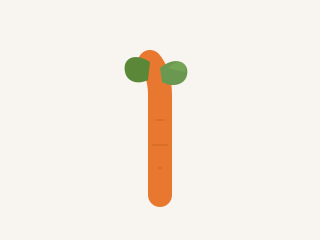
Carrot (Daucus carota) is a sweet, crisp taproot eaten raw, roasted, stewed, juiced, and pureed. Modern orange types dominate, but purple, yellow, white, and red heritage colours bring different pigment and flavour notes. Young bunching carrots are tender; large storage roots sweeten after cold weather. Mirepoix, stews, cakes, salads, and pickles all rely on carrots. Peel or scrub; cores of older roots can be woody. Pair with cumin, coriander, butter, citrus, ginger, or dill.
Track this ingredient
Cuts & parts
Breeds & varieties
A sample of named types with their own origin and culinary profiles. Showing 10 of 14.


Characteristics
Preparations
Provenance
Sources
Traits
Nutrition and pairings
Nutrition
Typical values per 100 g edible portion. Nutrient names open the reference page.
Nutrition Facts
Per 100 g edible portion
Amount per 100 g
- Total Fat 0.31 g
- Saturated Fat 0.05 g
- Trans Fat 0 g
- Monounsaturated Fat 0.05 g
- Polyunsaturated Fat 0.15 g
- Cholesterol 0 mg
- Sodium 20.2 mg
- Salt 0.05 g
- Total Carbohydrate 7.42 g
- Dietary Fibre 2.34 g
- Total Sugars 3.08 g
- Complex / starch 2.05 g
- Protein 1.84 g
- Water 90.6 g
- Energy 33.8 kcal
- Water 90.6 g
- Carbohydrates 7.42 g
- Sugars 3.08 g
- Monosaccharides 2.16 g
- Disaccharides 0.92 g
- Starch 2.05 g
- Amylose 0.51 g
- Amylopectin 1.54 g
- Digestible Starch 1.74 g
- Resistant Starch 0.21 g
- Fibre 2.34 g
- Soluble Fibre 0.82 g
- Insoluble Fibre 1.52 g
- Protein 1.84 g
- Plant Protein 1.75 g
- Fat 0.31 g
- Saturated Fat 0.05 g
- Monounsaturated Fat 0.05 g
- Polyunsaturated Fat 0.15 g
- Vitamins 304 mg
- Vitamin A 225 µg
- Vitamin B1 — Thiamine 0.07 mg
- Vitamin B2 — Riboflavin 0.09 mg
- Vitamin B3 — Niacin 0.64 mg
- Vitamin B5 — Pantothenic Acid 0.32 mg
- Vitamin B6 0.16 mg
- Vitamin B7 — Biotin 1.6 µg
- Vitamin B9 — Folate 30.8 µg
- Vitamin C 20 mg
- Vitamin E 0.4 mg
- Vitamin K 24.9 µg
- Minerals 437 mg
- Major Minerals 430 mg
- Trace Minerals 6.4 mg
- Salt 0.05 g
- Sodium Chloride 0.05 g
Vitamins
vitamin-c: 20 · vitamin-a: 225 · vitamin-b1-thiamine: 0.07 · vitamin-b2-riboflavin: 0.09 · vitamin-b3-niacin: 0.64 · vitamin-b5-pantothenic-acid: 0.32 · vitamin-b6: 0.16 · vitamin-b7-biotin: 1.6 · vitamin-b9-folate: 30.8 · vitamin-e: 0.4 · vitamin-k: 24.9 ·
Minerals
Sodium: 20.19 · Potassium: 375 · Calcium: 35 · Iron: 1 · Zinc: 0.4 · Iodine: 5 ·
Most vegetables are high-water, low-energy, with fibre and potassium ahead of protein.
Grading systems
Grades are placed along a shared scale so systems can be compared side by side.
History
Purple and yellow carrots were cultivated in Afghanistan and Central Asia.
Dutch breeders stabilised orange carrots that became the global commercial type.
Industrial canning, baby food, and fresh packing made carrots a universal staple.
Baby cut-and-peel carrots and rainbow heritage packs reshaped retail presentation.