
Fruit
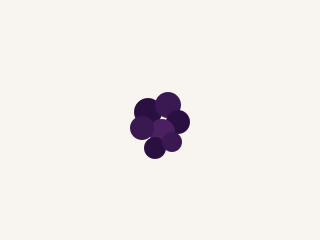
Blackberry
Blackberry is an aggregate fruit of Rubus species—clusters of juicy drupelets around a core that usually stays with the fruit when picked (unlike raspberries). Flavour runs sweet-tart to deep winey; aroma is floral and bramble-like. Fully black, plump berries are ripe; red ones are underripe and sharp. Fresh eating, pies, crumbles, jams, and coulis are classic uses. Berries are fragile, mould-prone, and best used within a day or two of peak. Wild and cultivated canes supply fruit; thornless cultivars ease picking. Freeze on trays for winter baking.
Track this ingredient
Cuts & parts



Breeds & varieties
A sample of named types with their own origin and culinary profiles.


Characteristics
Preparations
Provenance
Sources
Traits
Nutrition and pairings
Nutrition
Typical values per 100 g edible portion. Nutrient names open the reference page.
Nutrition Facts
Per 100 g edible portion
Amount per 100 g
- Total Fat 0.32 g
- Saturated Fat 0.05 g
- Trans Fat 0 g
- Monounsaturated Fat 0.11 g
- Polyunsaturated Fat 0.1 g
- Cholesterol 0 mg
- Sodium 4.73 mg
- Salt 0.01 g
- Total Carbohydrate 12.1 g
- Dietary Fibre 1.96 g
- Total Sugars 10.5 g
- Complex / starch 1 g
- Protein 0.76 g
- Water 90.1 g
- Energy 54.6 kcal
- Water 90.1 g
- Carbohydrates 12.1 g
- Sugars 10.5 g
- Monosaccharides 7.38 g
- Disaccharides 3.16 g
- Starch 1 g
- Amylose 0.25 g
- Amylopectin 0.75 g
- Digestible Starch 0.85 g
- Resistant Starch 0.1 g
- Fibre 1.96 g
- Soluble Fibre 0.69 g
- Insoluble Fibre 1.27 g
- Protein 0.76 g
- Plant Protein 0.72 g
- Fat 0.32 g
- Saturated Fat 0.05 g
- Monounsaturated Fat 0.11 g
- Polyunsaturated Fat 0.1 g
- Vitamins 56.4 mg
- Vitamin A 20 µg
- Vitamin B1 — Thiamine 0.03 mg
- Vitamin B2 — Riboflavin 0.04 mg
- Vitamin B3 — Niacin 0.39 mg
- Vitamin B5 — Pantothenic Acid 0.19 mg
- Vitamin B6 0.08 mg
- Vitamin B7 — Biotin 0.9 µg
- Vitamin B9 — Folate 14 µg
- Vitamin C 16 mg
- Vitamin E 0.27 mg
- Vitamin K 4.5 µg
- Minerals 413 mg
- Major Minerals 407 mg
- Trace Minerals 6 mg
- Salt 0.01 g
- Sodium Chloride 0.01 g
Vitamins
vitamin-c: 16 · vitamin-a: 20 · vitamin-b1-thiamine: 0.03 · vitamin-b2-riboflavin: 0.04 · vitamin-b3-niacin: 0.39 · vitamin-b5-pantothenic-acid: 0.19 · vitamin-b6: 0.08 · vitamin-b7-biotin: 0.9 · vitamin-b9-folate: 14 · vitamin-e: 0.27 · vitamin-k: 4.5 ·
Minerals
Sodium: 4.73 · Potassium: 371 · Calcium: 31 · Iron: 0.6 · Zinc: 0.4 · Iodine: 5 ·
Fruit energy is mostly natural sugars with fibre and vitamin C varying by species.
Grading systems
Grades are placed along a shared scale so systems can be compared side by side.
History
Wild blackberries were gathered across temperate Europe, Asia, and North America long before cultivation.
American breeding and garden canes expanded cultivated blackberry production.
Commercial canning and jam made blackberries a pantry preserve staple.
Thornless cultivars and cold-chain packs widened fresh retail supply.