
Herb
Lavender
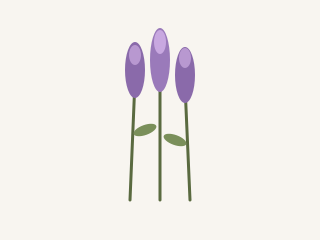
Culinary lavender is the flower bud of selected Lavandula types used sparingly in baking, honey, herb blends, and savoury Provençal dishes. English lavender (Lavandula angustifolia) is preferred for food; spike and lavandin types are stronger and more camphoraceous. Overuse tastes soapy. Buds are dried for herbes de Provence, sugar, and syrups; fresh flowers garnish desserts. Only unsprayed culinary-grade flowers should be eaten.
Also known as: Lavande, Lavanda
Track this ingredient
Cuts & parts

Breeds & varieties
A sample of named types with their own origin and culinary profiles. Showing 10 of 15.


Characteristics
Preparations
Provenance
Sources
Traits
Nutrition and pairings
Nutrition
Typical values per 100 g edible portion. Nutrient names open the reference page.
Nutrition Facts
Per 100 g edible portion
Amount per 100 g
- Total Fat 0.83 g
- Saturated Fat 0.19 g
- Trans Fat 0 g
- Monounsaturated Fat 0.11 g
- Polyunsaturated Fat 0.4 g
- Cholesterol 0 mg
- Sodium 25.3 mg
- Salt 0.05 g
- Total Carbohydrate 6.6 g
- Dietary Fibre 4.27 g
- Total Sugars 1 g
- Complex / starch 0.94 g
- Protein 2.87 g
- Water 83.1 g
- Energy 38 kcal
- Water 83.1 g
- Carbohydrates 6.6 g
- Sugars 1 g
- Monosaccharides 0.7 g
- Disaccharides 0.3 g
- Starch 0.94 g
- Amylose 0.24 g
- Amylopectin 0.71 g
- Digestible Starch 0.8 g
- Resistant Starch 0.09 g
- Fibre 4.27 g
- Soluble Fibre 1.49 g
- Insoluble Fibre 2.78 g
- Protein 2.87 g
- Plant Protein 2.73 g
- Fat 0.83 g
- Saturated Fat 0.19 g
- Monounsaturated Fat 0.11 g
- Polyunsaturated Fat 0.4 g
- Vitamins 406 mg
- Vitamin A 20 µg
- Vitamin B1 — Thiamine 0.09 mg
- Vitamin B2 — Riboflavin 0.16 mg
- Vitamin B3 — Niacin 1.06 mg
- Vitamin B5 — Pantothenic Acid 0.42 mg
- Vitamin B6 0.21 mg
- Vitamin B7 — Biotin 2.1 µg
- Vitamin B9 — Folate 81.4 µg
- Vitamin C 2 mg
- Vitamin E 2 mg
- Vitamin K 296 µg
- Minerals 230 mg
- Major Minerals 223 mg
- Trace Minerals 6.8 mg
- Salt 0.05 g
- Sodium Chloride 0.05 g
Vitamins
vitamin-c: 2 · vitamin-a: 20 · vitamin-b1-thiamine: 0.09 · vitamin-b2-riboflavin: 0.16 · vitamin-b3-niacin: 1.06 · vitamin-b5-pantothenic-acid: 0.42 · vitamin-b6: 0.21 · vitamin-b7-biotin: 2.1 · vitamin-b9-folate: 81.4 · vitamin-e: 2 · vitamin-k: 296.4 ·
Minerals
Sodium: 25.33 · Potassium: 159 · Calcium: 39 · Iron: 1.4 · Zinc: 0.4 · Iodine: 5 ·
Fresh herbs are aromatic leaves—modest macros, concentrated micronutrients and polyphenols per gram dry.
History
Mediterranean peoples used lavender for fragrance, washing, and occasional cookery.
Provençal cultivation expanded lavender for perfume, with culinary use in regional sweets and meats.
Herbes de Provence blends popularised dried lavender buds in savoury seasoning.
Artisan baking and cocktail culture revived measured culinary lavender worldwide.