
Vegetable
Green Bean
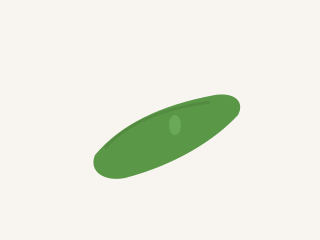
Green bean (Phaseolus vulgaris) is the immature pod eaten whole before seeds fully swell—also called string bean or snap bean when the string is bred out. Good pods are slender, firm, and snap cleanly; over-mature beans turn puffy, seedy, and fibrous. Flavour is mild, grassy-sweet when fresh; filet/haricot vert types are thinner and more refined than wide Romano flat beans. Blanch and shock for salads, steam or sauté for sides, roast or stir-fry for deeper flavour, or pickle for pantry jars. Trim stem ends; leave tails if tender. Avoid grey, limp, or heavily scarred pods. Fresh beans beat long-stored ones; frozen whole beans are a fair winter substitute when blanched properly before freezing.
Track this ingredient
Cuts & parts
Breeds & varieties
A sample of named types with their own origin and culinary profiles.


Characteristics
Preparations
Provenance
Sources
Traits
Nutrition and pairings
Nutrition
Typical values per 100 g edible portion. Nutrient names open the reference page.
Nutrition Facts
Per 100 g edible portion
Amount per 100 g
- Total Fat 0.32 g
- Saturated Fat 0.05 g
- Trans Fat 0 g
- Monounsaturated Fat 0.05 g
- Polyunsaturated Fat 0.15 g
- Cholesterol 0 mg
- Sodium 21.1 mg
- Salt 0.05 g
- Total Carbohydrate 6.48 g
- Dietary Fibre 2.53 g
- Total Sugars 2.82 g
- Complex / starch 2.11 g
- Protein 2.07 g
- Water 83 g
- Energy 37.3 kcal
- Water 83 g
- Carbohydrates 6.48 g
- Sugars 2.82 g
- Monosaccharides 1.98 g
- Disaccharides 0.85 g
- Starch 2.11 g
- Amylose 0.53 g
- Amylopectin 1.58 g
- Digestible Starch 1.79 g
- Resistant Starch 0.21 g
- Fibre 2.53 g
- Soluble Fibre 0.89 g
- Insoluble Fibre 1.64 g
- Protein 2.07 g
- Plant Protein 1.97 g
- Fat 0.32 g
- Saturated Fat 0.05 g
- Monounsaturated Fat 0.05 g
- Polyunsaturated Fat 0.15 g
- Vitamins 119 mg
- Vitamin A 20 µg
- Vitamin B1 — Thiamine 0.06 mg
- Vitamin B2 — Riboflavin 0.08 mg
- Vitamin B3 — Niacin 0.58 mg
- Vitamin B5 — Pantothenic Acid 0.29 mg
- Vitamin B6 0.14 mg
- Vitamin B7 — Biotin 1.4 µg
- Vitamin B9 — Folate 28 µg
- Vitamin C 45 mg
- Vitamin E 0.37 mg
- Vitamin K 22.6 µg
- Minerals 527 mg
- Major Minerals 521 mg
- Trace Minerals 5.9 mg
- Salt 0.05 g
- Sodium Chloride 0.05 g
Vitamins
vitamin-c: 45 · vitamin-a: 20 · vitamin-b1-thiamine: 0.06 · vitamin-b2-riboflavin: 0.08 · vitamin-b3-niacin: 0.58 · vitamin-b5-pantothenic-acid: 0.29 · vitamin-b6: 0.14 · vitamin-b7-biotin: 1.4 · vitamin-b9-folate: 28 · vitamin-e: 0.37 · vitamin-k: 22.6 ·
Minerals
Sodium: 21.05 · Potassium: 440 · Calcium: 60 · Iron: 0.5 · Zinc: 0.4 · Iodine: 5 ·
Most vegetables are high-water, low-energy, with fibre and potassium ahead of protein.
Grading systems
Grades are placed along a shared scale so systems can be compared side by side.
History
Green Bean was used as a vegetable food in regional diets long before industrial packing and global year-round supply.
Trade, migration, and selection spread distinctive Green Bean types and preparations into new climates and cuisines.
Modern production, storage, and transport made Green Bean a regular purchase far from where it is grown or raised.
Cooks now treat Green Bean as both staple and specialty, with more attention to provenance, variety, and form.