
Poultry
Ostrich
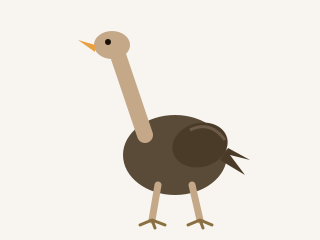
Ostrich is a lean red meat from the world's largest living bird, offering beef-like versatility with significantly lower fat and a mild, slightly sweet flavour. Farmed primarily for meat, leather, and feathers, ostrich responds well to quick, high-heat cooking that preserves its naturally tender texture. Once associated with South African game farming and biltong traditions, ostrich has gained global niche demand as a healthy alternative protein. Premium cuts such as fan fillet and strip steak reward precise searing, while trim and ground meat suit burgers, sausages, and dried snacks.
Track this ingredient
Cuts & parts








Breeds & varieties
A sample of named types with their own origin and culinary profiles. Showing 10 of 11.


Characteristics
Preparations
Provenance
Sources
Traits
Nutrition and pairings
Nutrition
Typical values per 100 g edible portion. Nutrient names open the reference page.
Nutrition Facts
Per 100 g edible portion
Amount per 100 g
- Total Fat 9.67 g
- Saturated Fat 3.14 g
- Trans Fat 0.1 g
- Monounsaturated Fat 3.73 g
- Polyunsaturated Fat 1.97 g
- Cholesterol 89.6 mg
- Sodium 71 mg
- Salt 0.15 g
- Total Carbohydrate 1.05 g
- Dietary Fibre 0 g
- Total Sugars 0.53 g
- Complex / starch 0 g
- Protein 23.4 g
- Water 60.1 g
- Energy 172 kcal
- Water 60.1 g
- Carbohydrates 1.05 g
- Sugars 0.53 g
- Monosaccharides 0.38 g
- Disaccharides 0.16 g
- Protein 23.4 g
- Animal Protein 22.3 g
- Fat 9.67 g
- Saturated Fat 3.14 g
- Monounsaturated Fat 3.73 g
- Polyunsaturated Fat 1.97 g
- Trans Fat 0.1 g
- Vitamins 42.6 mg
- Vitamin A 20 µg
- Vitamin B1 — Thiamine 0.07 mg
- Vitamin B2 — Riboflavin 0.13 mg
- Vitamin B3 — Niacin 6.66 mg
- Vitamin B5 — Pantothenic Acid 0.82 mg
- Vitamin B6 0.59 mg
- Vitamin B7 — Biotin 2.3 µg
- Vitamin B9 — Folate 6.9 µg
- Vitamin B12 — Cobalamin 1.5 µg
- Vitamin C 2 mg
- Vitamin D 0.2 µg
- Vitamin E 0.34 mg
- Vitamin K 1.1 µg
- Minerals 337 mg
- Major Minerals 331 mg
- Trace Minerals 5.9 mg
- Salt 0.15 g
- Sodium Chloride 0.15 g
- Cholesterol 89.6 mg
Vitamins
vitamin-c: 2 · vitamin-b12-cobalamin: 1.5 · vitamin-a: 20 · vitamin-b1-thiamine: 0.07 · vitamin-b2-riboflavin: 0.13 · vitamin-b3-niacin: 6.66 · vitamin-b5-pantothenic-acid: 0.82 · vitamin-b6: 0.59 · vitamin-b7-biotin: 2.3 · vitamin-b9-folate: 6.9 · vitamin-d: 0.2 · vitamin-e: 0.34 · vitamin-k: 1.1 ·
Minerals
Sodium: 71.04 · Potassium: 210 · Calcium: 50 · Iron: 0.5 · Zinc: 0.4 · Iodine: 5 ·
Poultry muscle is relatively lean; skin and dark meat raise fat and energy.
Grading systems
Grades are placed along a shared scale so systems can be compared side by side.
History
Indigenous peoples across Africa hunted wild ostrich for meat, eggs, feathers, and leather long before domestication attempts.
Commercial ostrich farming emerged in South Africa, driven initially by feather trade and later by meat production.
International health-conscious dining trends and biltong exports expanded global awareness of ostrich as a farmed red meat.
Ostrich farming spread to Europe, North America, and Australia as a specialty low-fat protein with established export supply chains.