
Fruit
Hawthorn
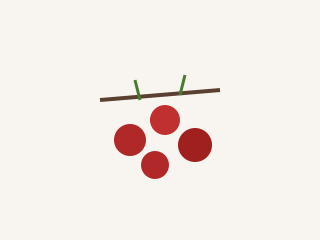
Hawthorn berries (Crataegus spp.) are small pomes used in Chinese snacks, European foraged jellies, and traditional preparations. Flavour is mild apple-berry with astringency when underripe. Cook into jellies, leathers, and sweet-sour Chinese snacks (tanghulu-style or slices). Remove seeds for fine purées. Not a dessert berry raw for most palates.
Track this ingredient
Cuts & parts

Breeds & varieties
A sample of named types with their own origin and culinary profiles.
Characteristics
Preparations
Provenance
Sources
Traits
Nutrition and pairings
Nutrition
Typical values per 100 g edible portion. Nutrient names open the reference page.
Nutrition Facts
Per 100 g edible portion
Amount per 100 g
- Total Fat 0.28 g
- Saturated Fat 0.05 g
- Trans Fat 0 g
- Monounsaturated Fat 0.1 g
- Polyunsaturated Fat 0.1 g
- Cholesterol 0 mg
- Sodium 4.89 mg
- Salt 0.01 g
- Total Carbohydrate 14 g
- Dietary Fibre 1.86 g
- Total Sugars 10.2 g
- Complex / starch 0.97 g
- Protein 0.82 g
- Water 84 g
- Energy 53.8 kcal
- Water 84 g
- Carbohydrates 14 g
- Sugars 10.2 g
- Monosaccharides 7.14 g
- Disaccharides 3.06 g
- Starch 0.97 g
- Amylose 0.24 g
- Amylopectin 0.73 g
- Digestible Starch 0.82 g
- Resistant Starch 0.1 g
- Fibre 1.86 g
- Soluble Fibre 0.65 g
- Insoluble Fibre 1.21 g
- Protein 0.82 g
- Plant Protein 0.78 g
- Fat 0.28 g
- Saturated Fat 0.05 g
- Monounsaturated Fat 0.1 g
- Polyunsaturated Fat 0.1 g
- Vitamins 89.9 mg
- Vitamin A 20 µg
- Vitamin B1 — Thiamine 0.03 mg
- Vitamin B2 — Riboflavin 0.04 mg
- Vitamin B3 — Niacin 0.41 mg
- Vitamin B5 — Pantothenic Acid 0.21 mg
- Vitamin B6 0.08 mg
- Vitamin B7 — Biotin 1 µg
- Vitamin B9 — Folate 15 µg
- Vitamin C 48 mg
- Vitamin E 0.29 mg
- Vitamin K 4.8 µg
- Minerals 357 mg
- Major Minerals 351 mg
- Trace Minerals 6.2 mg
- Salt 0.01 g
- Sodium Chloride 0.01 g
Vitamins
vitamin-c: 48 · vitamin-a: 20 · vitamin-b1-thiamine: 0.03 · vitamin-b2-riboflavin: 0.04 · vitamin-b3-niacin: 0.41 · vitamin-b5-pantothenic-acid: 0.21 · vitamin-b6: 0.08 · vitamin-b7-biotin: 1 · vitamin-b9-folate: 15 · vitamin-e: 0.29 · vitamin-k: 4.8 ·
Minerals
Sodium: 4.89 · Potassium: 283 · Calcium: 63 · Iron: 0.8 · Zinc: 0.4 · Iodine: 5 ·
Fruit energy is mostly natural sugars with fibre and vitamin C varying by species.
History
Chinese food culture used hawthorn in sweet-sour snacks and digests.
English foragers made hawthorn jelly from hedgerow berries.
Industrial hawthorn wafers and candies became popular Chinese snacks.