
Vegetable
Bean Sprout
Vigna radiata
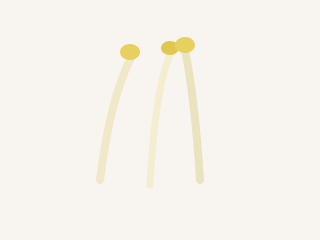
Bean sprouts are germinated legume seeds sold as a crisp, pale vegetable—most often mung bean sprouts with long white hypocotyls and tiny yellow heads. Flavour is mild, grassy, and watery-fresh; texture is crunchy when briefly cooked and limp when overdone. Toss into stir-fries at the last seconds, pile into pho, or eat raw in sandwiches where food safety allows. Rinse well; use within a day or two as sprouts spoil fast. Related to but distinct from the dry bean crop—sold as a fresh sprout product.
Track this ingredient
Cuts & parts

Breeds & varieties
A sample of named types with their own origin and culinary profiles.
Characteristics
Preparations
Provenance
Sources
Traits
Nutrition and pairings
Nutrition
Typical values per 100 g edible portion. Nutrient names open the reference page.
Nutrition Facts
Per 100 g edible portion
Amount per 100 g
- Total Fat 0.28 g
- Saturated Fat 0.06 g
- Trans Fat 0 g
- Monounsaturated Fat 0.06 g
- Polyunsaturated Fat 0.16 g
- Cholesterol 0 mg
- Sodium 20 mg
- Salt 0.05 g
- Total Carbohydrate 6.81 g
- Dietary Fibre 2.49 g
- Total Sugars 2.78 g
- Complex / starch 1.95 g
- Protein 1.98 g
- Water 89.2 g
- Energy 37.7 kcal
- Water 89.2 g
- Carbohydrates 6.81 g
- Sugars 2.78 g
- Monosaccharides 1.94 g
- Disaccharides 0.84 g
- Starch 1.95 g
- Amylose 0.49 g
- Amylopectin 1.46 g
- Digestible Starch 1.66 g
- Resistant Starch 0.2 g
- Fibre 2.49 g
- Soluble Fibre 0.87 g
- Insoluble Fibre 1.62 g
- Protein 1.98 g
- Plant Protein 2.02 g
- Fat 0.28 g
- Saturated Fat 0.06 g
- Monounsaturated Fat 0.06 g
- Polyunsaturated Fat 0.16 g
- Vitamins 103 mg
- Vitamin A 20 µg
- Vitamin B1 — Thiamine 0.06 mg
- Vitamin B2 — Riboflavin 0.08 mg
- Vitamin B3 — Niacin 0.59 mg
- Vitamin B5 — Pantothenic Acid 0.29 mg
- Vitamin B6 0.14 mg
- Vitamin B7 — Biotin 1.4 µg
- Vitamin B9 — Folate 28.3 µg
- Vitamin C 29 mg
- Vitamin E 0.37 mg
- Vitamin K 22.9 µg
- Minerals 494 mg
- Major Minerals 488 mg
- Trace Minerals 6.3 mg
- Salt 0.05 g
- Sodium Chloride 0.05 g
Vitamins
vitamin-c: 29 · vitamin-a: 20 · vitamin-b1-thiamine: 0.06 · vitamin-b2-riboflavin: 0.08 · vitamin-b3-niacin: 0.59 · vitamin-b5-pantothenic-acid: 0.29 · vitamin-b6: 0.14 · vitamin-b7-biotin: 1.4 · vitamin-b9-folate: 28.3 · vitamin-e: 0.37 · vitamin-k: 22.9 ·
Minerals
Sodium: 20.02 · Potassium: 424 · Calcium: 44 · Iron: 0.9 · Zinc: 0.4 · Iodine: 5 ·
Most vegetables are high-water, low-energy, with fibre and potassium ahead of protein.
In the kitchen
Culinary partners and combinations that usually underperform with Bean Sprout.
Pairs well with
Classic and complementary matches
History
Chinese cookery sprouted mung beans as a fresh vegetable.
Bean sprouts became a global Chinese restaurant staple.
Supermarket packs of mung bean sprouts spread beyond Asian groceries.
Food-safety rules tightened around raw sprout service in some countries.