
Poultry
Pheasant
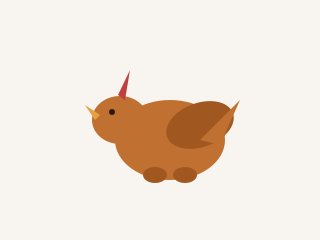
Pheasant is a classic game bird with lean, aromatic meat that benefits from careful cooking, barding, or moist heat. Common pheasants dominate European shoots and farmed supply; whole birds, breasts, and legs are the usual cuts. Younger birds roast well; older birds suit braises, pies, and terrines. Hang time and seasonality shape flavour intensity in traditional game cookery.
Also known as: Faisan, Zhì
Track this ingredient
Cuts & parts










Breeds & varieties
A sample of named types with their own origin and culinary profiles. Showing 10 of 12.


Characteristics
Preparations
Provenance
Sources
Traits
Nutrition and pairings
Nutrition
Typical values per 100 g edible portion. Nutrient names open the reference page.
Nutrition Facts
Per 100 g edible portion
Amount per 100 g
- Total Fat 10.7 g
- Saturated Fat 2.98 g
- Trans Fat 0.1 g
- Monounsaturated Fat 3.91 g
- Polyunsaturated Fat 1.85 g
- Cholesterol 96.7 mg
- Sodium 73.1 mg
- Salt 0.14 g
- Total Carbohydrate 1.02 g
- Dietary Fibre 0 g
- Total Sugars 0.54 g
- Complex / starch 0 g
- Protein 21.2 g
- Water 68.4 g
- Energy 183 kcal
- Water 68.4 g
- Carbohydrates 1.02 g
- Sugars 0.54 g
- Monosaccharides 0.38 g
- Disaccharides 0.17 g
- Protein 21.2 g
- Animal Protein 20.2 g
- Fat 10.7 g
- Saturated Fat 2.98 g
- Monounsaturated Fat 3.91 g
- Polyunsaturated Fat 1.85 g
- Trans Fat 0.1 g
- Vitamins 46.3 mg
- Vitamin A 20 µg
- Vitamin B1 — Thiamine 0.07 mg
- Vitamin B2 — Riboflavin 0.18 mg
- Vitamin B3 — Niacin 9.33 mg
- Vitamin B5 — Pantothenic Acid 1.16 mg
- Vitamin B6 0.57 mg
- Vitamin B7 — Biotin 2.3 µg
- Vitamin B9 — Folate 6.8 µg
- Vitamin B12 — Cobalamin 2.3 µg
- Vitamin C 2 mg
- Vitamin D 0.2 µg
- Vitamin E 0.33 mg
- Vitamin K 1.1 µg
- Minerals 356 mg
- Major Minerals 349 mg
- Trace Minerals 6.7 mg
- Salt 0.14 g
- Sodium Chloride 0.14 g
- Cholesterol 96.7 mg
Vitamins
vitamin-c: 2 · vitamin-b12-cobalamin: 2.3 · vitamin-a: 20 · vitamin-b1-thiamine: 0.07 · vitamin-b2-riboflavin: 0.18 · vitamin-b3-niacin: 9.33 · vitamin-b5-pantothenic-acid: 1.16 · vitamin-b6: 0.57 · vitamin-b7-biotin: 2.3 · vitamin-b9-folate: 6.8 · vitamin-d: 0.2 · vitamin-e: 0.33 · vitamin-k: 1.1 ·
Minerals
Sodium: 73.06 · Potassium: 238 · Calcium: 38 · Iron: 1.3 · Zinc: 0.4 · Iodine: 5 ·
Poultry muscle is relatively lean; skin and dark meat raise fat and energy.
Grading systems
Grades are placed along a shared scale so systems can be compared side by side.
History
Common pheasants native to Asia were hunted and later transported along trade routes.
Pheasants became established in European hunting estates and medieval banquets.
Driven shoots and gamekeeping industrialised pheasant supply for British tables.
Farmed and wild pheasant both supplied restaurants seeking seasonal game poultry.