
Fish
Zander
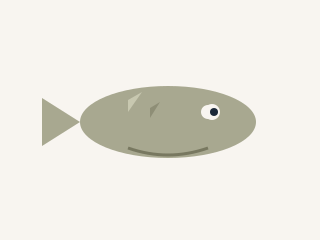
Zander (Sander lucioperca), also called pike-perch, is a European freshwater predator with firm, white, mildly sweet flesh and large flakes—closely related to North American walleye. It is a restaurant favourite from the Baltic to Central Europe for fillets that hold together better than soft carp. Farmed and wild supplies both appear on menus. Pan-fry skin-on, poach in white wine court-bouillon, bake, or serve as schnitzel-style fillets. Pair with butter sauces, dill, cucumber, and light riesling-friendly sides. Pin bones need careful removal. Cook to just opaque; the lean meat dries if held. Do not confuse with true pike (Esox), which has more Y-bones and a different texture.
Track this ingredient
Cuts & parts










Breeds & varieties
A sample of named types with their own origin and culinary profiles.


Characteristics
Preparations
Provenance
Sources
Traits
Nutrition and pairings
Nutrition
Typical values per 100 g edible portion. Nutrient names open the reference page.
Nutrition Facts
Per 100 g edible portion
Amount per 100 g
- Total Fat 5.16 g
- Saturated Fat 0.95 g
- Trans Fat 0 g
- Monounsaturated Fat 1.98 g
- Polyunsaturated Fat 1.88 g
- Cholesterol 51 mg
- Sodium 84.7 mg
- Salt 0.19 g
- Total Carbohydrate 0 g
- Dietary Fibre 0 g
- Total Sugars 0 g
- Complex / starch 0 g
- Protein 21.2 g
- Water 67 g
- Energy 129 kcal
- Water 67 g
- Protein 21.2 g
- Animal Protein 20.2 g
- Fat 5.16 g
- Saturated Fat 0.95 g
- Monounsaturated Fat 1.98 g
- Polyunsaturated Fat 1.88 g
- Vitamins 49.6 mg
- Vitamin A 20 µg
- Vitamin B1 — Thiamine 0.08 mg
- Vitamin B2 — Riboflavin 0.18 mg
- Vitamin B3 — Niacin 4.64 mg
- Vitamin B5 — Pantothenic Acid 0.81 mg
- Vitamin B6 0.46 mg
- Vitamin B7 — Biotin 3.4 µg
- Vitamin B9 — Folate 13.5 µg
- Vitamin B12 — Cobalamin 1.7 µg
- Vitamin C 2 mg
- Vitamin D 1.7 µg
- Vitamin E 0.66 mg
- Vitamin K 0.5 µg
- Minerals 502 mg
- Major Minerals 369 mg
- Trace Minerals 133 mg
- Salt 0.19 g
- Sodium Chloride 0.19 g
- Cholesterol 51 mg
Vitamins
vitamin-c: 2 · vitamin-b12-cobalamin: 1.7 · vitamin-a: 20 · vitamin-b1-thiamine: 0.08 · vitamin-b2-riboflavin: 0.18 · vitamin-b3-niacin: 4.64 · vitamin-b5-pantothenic-acid: 0.81 · vitamin-b6: 0.46 · vitamin-b7-biotin: 3.4 · vitamin-b9-folate: 13.5 · vitamin-d: 1.7 · vitamin-e: 0.66 · vitamin-k: 0.5 ·
Minerals
Sodium: 84.72 · Potassium: 232 · Calcium: 52 · Iron: 0.7 · Zinc: 0.4 · Iodine: 132 ·
Fish flesh is lean to oily depending on species; marine omega-3s rise in fatty fish.
History
Coastal and river fishing for zander and related species supplied essential protein long before agriculture spread globally.
Salting, drying, smoking, and fermenting extended the shelf life of zander and enabled long-distance trade.
Ice preservation and railway transport brought fresh zander to inland cities beyond fishing ports.
Industrial freezing, aquaculture, and global logistics made zander widely available in international markets.