
Meat
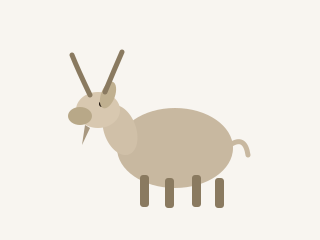
Goat
Goat meat (chevon or cabrito when young) is lean, mildly sweet, and widely eaten across Africa, Asia, the Middle East, the Caribbean, and Latin America. Younger animals are tender for grilling and roasting; mature goat suits curry, stew, and slow braises that break down connective tissue. Compared with lamb it is often leaner and slightly more robust. Cut selection and marinade practices matter more than with fattier red meats.
Also known as: Mutton (goat often sold as mutton), Cabrito
Track this ingredient
Cuts & parts



Breeds & varieties
A sample of named types with their own origin and culinary profiles. Showing 10 of 18.


Characteristics
Preparations
Provenance
Sources
Traits
Nutrition and pairings
Nutrition
Typical values per 100 g edible portion. Nutrient names open the reference page.
Nutrition Facts
Per 100 g edible portion
Amount per 100 g
- Total Fat 12.6 g
- Saturated Fat 4.86 g
- Trans Fat 0.2 g
- Monounsaturated Fat 4.88 g
- Polyunsaturated Fat 1.03 g
- Cholesterol 72.7 mg
- Sodium 57.1 mg
- Salt 0.15 g
- Total Carbohydrate 0 g
- Dietary Fibre 0 g
- Total Sugars 0 g
- Complex / starch 0 g
- Protein 22.9 g
- Water 58 g
- Energy 198 kcal
- Water 58 g
- Protein 22.9 g
- Animal Protein 21.7 g
- Fat 12.6 g
- Saturated Fat 4.86 g
- Monounsaturated Fat 4.88 g
- Polyunsaturated Fat 1.03 g
- Trans Fat 0.2 g
- Vitamins 41 mg
- Vitamin A 20 µg
- Vitamin B1 — Thiamine 0.07 mg
- Vitamin B2 — Riboflavin 0.18 mg
- Vitamin B3 — Niacin 4.96 mg
- Vitamin B5 — Pantothenic Acid 0.53 mg
- Vitamin B6 0.35 mg
- Vitamin B7 — Biotin 2.2 µg
- Vitamin B9 — Folate 6.9 µg
- Vitamin B12 — Cobalamin 2.2 µg
- Vitamin C 2 mg
- Vitamin D 0.2 µg
- Vitamin E 0.25 mg
- Vitamin K 1.2 µg
- Minerals 342 mg
- Major Minerals 331 mg
- Trace Minerals 10.4 mg
- Salt 0.15 g
- Sodium Chloride 0.15 g
- Cholesterol 72.7 mg
Vitamins
vitamin-c: 2 · vitamin-b12-cobalamin: 2.2 · vitamin-a: 20 · vitamin-b1-thiamine: 0.07 · vitamin-b2-riboflavin: 0.18 · vitamin-b3-niacin: 4.96 · vitamin-b5-pantothenic-acid: 0.53 · vitamin-b6: 0.35 · vitamin-b7-biotin: 2.2 · vitamin-b9-folate: 6.9 · vitamin-d: 0.2 · vitamin-e: 0.25 · vitamin-k: 1.2 ·
Minerals
Sodium: 57.14 · Potassium: 217 · Calcium: 57 · Iron: 2.7 · Zinc: 2.7 · Iodine: 5 ·
Muscle meat is protein-dense with variable marbling fat.
Grading systems
Grades are placed along a shared scale so systems can be compared side by side.
History
Goats were among the earliest domesticated livestock in the Fertile Crescent, valued for meat, milk, and hides.
Pastoral cultures across Africa, Arabia, and South Asia made goat a dietary staple in arid and highland regions.
Columbian exchange and colonial trade carried goat husbandry into the Americas and Caribbean.
Diaspora cuisines and health-focused demand increased goat meat visibility in Western specialty markets.