
Meat
Horse
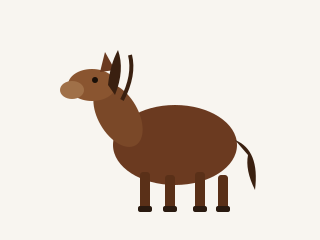
Horse meat is a lean, finely grained red meat with a slightly sweet, iron-rich flavour and deep colour. It has long been eaten in parts of Europe, Central Asia, and East Asia, where it is grilled, cured, or simmered in stews and sausages. Young horse (foal or yearling) is tender enough for steaks and carpaccio; older animals suit braising and charcuterie. Low intramuscular fat means careful cooking avoids dryness, while traditional curing produces distinctive dried products.
Also known as: Viande de cheval, Carne di cavallo, Basashi / Baniku
Track this ingredient
Cuts & parts








Breeds & varieties
A sample of named types with their own origin and culinary profiles.


Characteristics
Preparations
Provenance
Sources
Traits
Nutrition and pairings
Nutrition
Typical values per 100 g edible portion. Nutrient names open the reference page.
Nutrition Facts
Per 100 g edible portion
Amount per 100 g
- Total Fat 12.8 g
- Saturated Fat 4.96 g
- Trans Fat 0.2 g
- Monounsaturated Fat 5.11 g
- Polyunsaturated Fat 0.97 g
- Cholesterol 67.1 mg
- Sodium 55.2 mg
- Salt 0.15 g
- Total Carbohydrate 0 g
- Dietary Fibre 0 g
- Total Sugars 0 g
- Complex / starch 0 g
- Protein 20.5 g
- Water 61.6 g
- Energy 192 kcal
- Water 61.6 g
- Protein 20.5 g
- Animal Protein 19.5 g
- Fat 12.8 g
- Saturated Fat 4.96 g
- Monounsaturated Fat 5.11 g
- Polyunsaturated Fat 0.97 g
- Trans Fat 0.2 g
- Vitamins 41.3 mg
- Vitamin A 20 µg
- Vitamin B1 — Thiamine 0.08 mg
- Vitamin B2 — Riboflavin 0.19 mg
- Vitamin B3 — Niacin 5.06 mg
- Vitamin B5 — Pantothenic Acid 0.55 mg
- Vitamin B6 0.36 mg
- Vitamin B7 — Biotin 2.2 µg
- Vitamin B9 — Folate 7.1 µg
- Vitamin C 2 mg
- Vitamin D 0.2 µg
- Vitamin E 0.26 mg
- Vitamin K 1.3 µg
- Minerals 255 mg
- Major Minerals 245 mg
- Trace Minerals 10 mg
- Salt 0.15 g
- Sodium Chloride 0.15 g
- Cholesterol 67.1 mg
Vitamins
vitamin-c: 2 · vitamin-b12-cobalamin: 2 · vitamin-a: 20 · vitamin-b1-thiamine: 0.08 · vitamin-b2-riboflavin: 0.19 · vitamin-b3-niacin: 5.06 · vitamin-b5-pantothenic-acid: 0.55 · vitamin-b6: 0.36 · vitamin-b7-biotin: 2.2 · vitamin-b9-folate: 7.1 · vitamin-d: 0.2 · vitamin-e: 0.26 · vitamin-k: 1.3 ·
Minerals
Sodium: 55.2 · Potassium: 155 · Calcium: 35 · Iron: 2.5 · Zinc: 2.5 · Iodine: 5 ·
Muscle meat is protein-dense with variable marbling fat.
History
Horses were domesticated on the Eurasian steppe; meat remained a secondary product beside transport and warfare for millennia.
Horse meat consumption persisted in parts of continental Europe despite religious and cultural taboos elsewhere.
Legalisation and butchery regulation in France and neighbouring countries formalised commercial horse meat supply.
Specialty restaurants and Central Asian cuisine sustained demand while many markets restricted retail horse meat.