
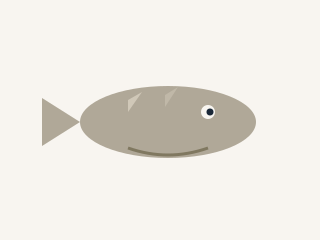
Fish
Ling
Ling (Molva molva and related gadiforms) is a long, eel-shaped white fish of North Atlantic cold waters, related to cod but leaner in outline and often sold as thick, flake-friendly fillets or salt-cured stockfish-style products. Flesh is mild, firm, and slightly sweet, with large flakes that hold in stews, bakes, and fried portions better than very soft white fish. The long body yields long loin fillets; the tail thins and can dry more quickly on the grill. European markets—especially Nordic, British, and Iberian—use ling in fish pies, salted and dried preparations, and restaurant white-fish plates as a cod alternative. Fresh fish should smell clean and marine, not ammonia; freeze carefully to limit drip loss. Longline and trawl fisheries supply most commercial fish; sustainability varies by stock, so provenance and gear matter when choosing.
Track this ingredient
Cuts & parts










Breeds & varieties
A sample of named types with their own origin and culinary profiles.


Characteristics
Preparations
Provenance
Sources
Traits
Nutrition and pairings
Nutrition
Typical values per 100 g edible portion. Nutrient names open the reference page.
Nutrition Facts
Per 100 g edible portion
Amount per 100 g
- Total Fat 5.02 g
- Saturated Fat 0.92 g
- Trans Fat 0 g
- Monounsaturated Fat 2.11 g
- Polyunsaturated Fat 1.89 g
- Cholesterol 52.6 mg
- Sodium 83.6 mg
- Salt 0.19 g
- Total Carbohydrate 0 g
- Dietary Fibre 0 g
- Total Sugars 0 g
- Complex / starch 0 g
- Protein 19.9 g
- Water 67.8 g
- Energy 122 kcal
- Water 67.8 g
- Protein 19.9 g
- Animal Protein 18.9 g
- Fat 5.02 g
- Saturated Fat 0.92 g
- Monounsaturated Fat 2.11 g
- Polyunsaturated Fat 1.89 g
- Vitamins 48.1 mg
- Vitamin A 20 µg
- Vitamin B1 — Thiamine 0.09 mg
- Vitamin B2 — Riboflavin 0.13 mg
- Vitamin B3 — Niacin 3.4 mg
- Vitamin B5 — Pantothenic Acid 0.59 mg
- Vitamin B6 0.33 mg
- Vitamin B7 — Biotin 2.5 µg
- Vitamin B9 — Folate 14 µg
- Vitamin B12 — Cobalamin 2.1 µg
- Vitamin C 2 mg
- Vitamin D 1.7 µg
- Vitamin E 0.69 mg
- Vitamin K 0.6 µg
- Minerals 413 mg
- Major Minerals 316 mg
- Trace Minerals 97.5 mg
- Salt 0.19 g
- Sodium Chloride 0.19 g
- Cholesterol 52.6 mg
Vitamins
vitamin-c: 2 · vitamin-b12-cobalamin: 2.1 · vitamin-a: 20 · vitamin-b1-thiamine: 0.09 · vitamin-b2-riboflavin: 0.13 · vitamin-b3-niacin: 3.4 · vitamin-b5-pantothenic-acid: 0.59 · vitamin-b6: 0.33 · vitamin-b7-biotin: 2.5 · vitamin-b9-folate: 14 · vitamin-d: 1.7 · vitamin-e: 0.69 · vitamin-k: 0.6 ·
Minerals
Sodium: 83.62 · Potassium: 196 · Calcium: 36 · Iron: 1.1 · Zinc: 0.4 · Iodine: 96 ·
Fish flesh is lean to oily depending on species; marine omega-3s rise in fatty fish.
History
Coastal and river fishing for ling and related species supplied essential protein long before agriculture spread globally.
Salting, drying, smoking, and fermenting extended the shelf life of ling and enabled long-distance trade.
Ice preservation and railway transport brought fresh ling to inland cities beyond fishing ports.
Industrial freezing, aquaculture, and global logistics made ling widely available in international markets.