
Meat
Camel
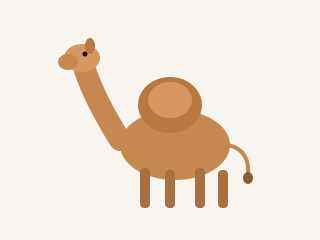
Camel is a lean red meat from dromedary and Bactrian camels, traditional across North Africa, the Middle East, and Central Asia. The flesh is mildly sweet, slightly coarse, and lower in fat than beef, with a flavour that sits between beef and game when young and more robust in mature animals. Shoulder, leg, and ribs suit slow braising and stews; tender loin cuts reward careful grilling. Camel meat underpins festival dishes, dried strips, and sausage traditions where camels are raised for transport and dairy as well as meat.
Also known as: Feral Camel, Bactrian Camel
Track this ingredient
Cuts & parts












Breeds & varieties
A sample of named types with their own origin and culinary profiles.


Characteristics
Preparations
Provenance
Sources
Traits
Nutrition and pairings
Nutrition
Typical values per 100 g edible portion. Nutrient names open the reference page.
Nutrition Facts
Per 100 g edible portion
Amount per 100 g
- Total Fat 11.4 g
- Saturated Fat 5.15 g
- Trans Fat 0.2 g
- Monounsaturated Fat 4.92 g
- Polyunsaturated Fat 0.93 g
- Cholesterol 64.5 mg
- Sodium 63.1 mg
- Salt 0.14 g
- Total Carbohydrate 0 g
- Dietary Fibre 0 g
- Total Sugars 0 g
- Complex / starch 0 g
- Protein 22.8 g
- Water 57.4 g
- Energy 216 kcal
- Water 57.4 g
- Protein 22.8 g
- Animal Protein 21.7 g
- Fat 11.4 g
- Saturated Fat 5.15 g
- Monounsaturated Fat 4.92 g
- Polyunsaturated Fat 0.93 g
- Trans Fat 0.2 g
- Vitamins 41.9 mg
- Vitamin A 20 µg
- Vitamin B1 — Thiamine 0.07 mg
- Vitamin B2 — Riboflavin 0.18 mg
- Vitamin B3 — Niacin 4.84 mg
- Vitamin B5 — Pantothenic Acid 0.52 mg
- Vitamin B6 0.34 mg
- Vitamin B7 — Biotin 2.1 µg
- Vitamin B9 — Folate 6.7 µg
- Vitamin B12 — Cobalamin 2.9 µg
- Vitamin C 2 mg
- Vitamin D 0.2 µg
- Vitamin E 0.25 mg
- Vitamin K 1.8 µg
- Minerals 362 mg
- Major Minerals 351 mg
- Trace Minerals 10.8 mg
- Salt 0.14 g
- Sodium Chloride 0.14 g
- Cholesterol 64.5 mg
Vitamins
vitamin-c: 2 · vitamin-b12-cobalamin: 2.9 · vitamin-a: 20 · vitamin-b1-thiamine: 0.07 · vitamin-b2-riboflavin: 0.18 · vitamin-b3-niacin: 4.84 · vitamin-b5-pantothenic-acid: 0.52 · vitamin-b6: 0.34 · vitamin-b7-biotin: 2.1 · vitamin-b9-folate: 6.7 · vitamin-d: 0.2 · vitamin-e: 0.25 · vitamin-k: 1.8 ·
Minerals
Sodium: 63.12 · Potassium: 244 · Calcium: 44 · Iron: 3.4 · Zinc: 2.4 · Iodine: 5 ·
Muscle meat is protein-dense with variable marbling fat.
History
Camels were domesticated in Arabia and Central Asia, supplying meat, milk, transport, and fibre to desert and steppe societies.
Islamic culinary and pastoral traditions embedded camel meat in Middle Eastern and North African feast and everyday cookery.
Commercial camel husbandry and export markets developed alongside dairy and tourism industries in arid regions.
Specialty export of camel meat and dried products reached restaurants and ethnic markets beyond traditional range states.