
Shellfish
Crayfish
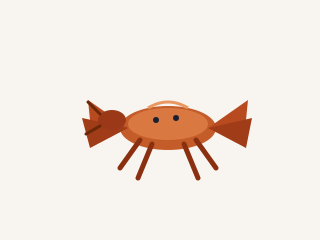
Crayfish (also crawfish or crawdad) are freshwater clawed crustaceans of the families Astacidae, Cambaridae, and Parastacidae—smaller than marine lobster but built on the same plan of sweet tail meat and useful claws. Live animals should be lively in cold water; cooked shells turn bright red to orange. Flavour is sweet and clean with a faint river or mud note depending on habitat and purge; Louisiana red swamp, European signal and noble, and Australian yabby or redclaw each cook a little differently. Classic uses include Cajun étouffée and crawfish boils, Swedish crayfish parties with dill, Chinese mala or garlic crayfish, and simple butter-sautéed tails. Boil or steam just until the meat turns opaque and pulls from the shell; overcooking dries the tail. Purge live crayfish in clean water before cooking when grit is a concern. Wild harvest and farmed supply both matter for invasive-species rules in some regions—check local guidance.
Also known as: Crawfish, Kräftor, 小龙虾, Yabby, Crayfish
Track this ingredient
Species
5 species. Open one to see its varieties.
 A
ARed Swamp Crawfish
Origin: US
 A
ANoble Crayfish
Origin: SE, FI
 A
ASignal Crayfish
Origin: GB, SE
 A
AYabby
Origin: AU
 A
ARedclaw
Cuts & parts
Characteristics
Preparations
Provenance
Sources
Traits
Nutrition and pairings
Nutrition
Typical values per 100 g edible portion. Nutrient names open the reference page.
Nutrition Facts
Per 100 g edible portion
Amount per 100 g
- Total Fat 4.75 g
- Saturated Fat 1.03 g
- Trans Fat 0 g
- Monounsaturated Fat 1.99 g
- Polyunsaturated Fat 1.89 g
- Cholesterol 51.2 mg
- Sodium 76.2 mg
- Salt 0.19 g
- Total Carbohydrate 0 g
- Dietary Fibre 0 g
- Total Sugars 0 g
- Complex / starch 0 g
- Protein 18.8 g
- Water 75.9 g
- Energy 139 kcal
- Water 75.9 g
- Protein 18.8 g
- Animal Protein 17.9 g
- Fat 4.75 g
- Saturated Fat 1.03 g
- Monounsaturated Fat 1.99 g
- Polyunsaturated Fat 1.89 g
- Vitamins 45.5 mg
- Vitamin A 20 µg
- Vitamin B1 — Thiamine 0.09 mg
- Vitamin B2 — Riboflavin 0.13 mg
- Vitamin B3 — Niacin 3.46 mg
- Vitamin B6 0.34 mg
- Vitamin B7 — Biotin 2.5 µg
- Vitamin B9 — Folate 9.9 µg
- Vitamin B12 — Cobalamin 3.4 µg
- Vitamin C 2 mg
- Vitamin D 1.8 µg
- Vitamin E 0.7 mg
- Vitamin K 0.6 µg
- Minerals 545 mg
- Major Minerals 394 mg
- Trace Minerals 151 mg
- Salt 0.19 g
- Sodium Chloride 0.19 g
- Cholesterol 51.2 mg
Vitamins
vitamin-c: 2 · vitamin-b12-cobalamin: 3.4 · vitamin-a: 20 · vitamin-b1-thiamine: 0.09 · vitamin-b2-riboflavin: 0.13 · vitamin-b3-niacin: 3.46 · vitamin-b5-pantothenic-acid: 0.6 · vitamin-b6: 0.34 · vitamin-b7-biotin: 2.5 · vitamin-b9-folate: 9.9 · vitamin-d: 1.8 · vitamin-e: 0.7 · vitamin-k: 0.6 ·
Minerals
Sodium: 76.24 · Potassium: 249 · Calcium: 69 · Iron: 1.4 · Zinc: 0.4 · Iodine: 149 ·
Fish flesh is lean to oily depending on species; marine omega-3s rise in fatty fish.
Grading systems
Grades are placed along a shared scale so systems can be compared side by side.
History
Freshwater crayfish were taken from rivers and lakes as everyday protein long before written recipes named them.
Scandinavian crayfish feasts with dill and aquavit became seasonal social ritual around late-summer catches.
Louisiana and Gulf coast cookery fixed crawfish boils and étouffée as regional icons of the American South.
Global aquaculture of red swamp, redclaw, and yabby expanded year-round supply beyond traditional wild seasons.