
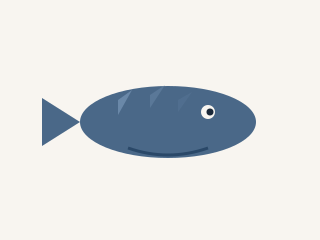
Fish
Skipjack
Skipjack tuna (Katsuwonus pelamis) is a small, fast-growing tuna with dark, meaty, strongly flavoured flesh—the backbone of most canned “light” tuna and of Japanese katsuobushi (smoked, fermented dried blocks for dashi). Fresh skipjack is firmer and less fatty than bluefin belly, with a pronounced marine taste that stands up to grill and curry. Pacific and Indian Ocean pole-and-line and purse-seine fisheries dominate supply. Use fresh loins for tataki, poke, and seared steaks; dried and smoked forms are pantry staples. Overcooking dries the lean muscle—pull while still slightly pink if serving as a steak. Prefer MSC or well-rated fisheries where labels allow.
Track this ingredient
Cuts & parts










Breeds & varieties
A sample of named types with their own origin and culinary profiles.


Characteristics
Preparations
Provenance
Sources
Traits
Nutrition and pairings
Nutrition
Typical values per 100 g edible portion. Nutrient names open the reference page.
Nutrition Facts
Per 100 g edible portion
Amount per 100 g
- Total Fat 5.11 g
- Saturated Fat 0.94 g
- Trans Fat 0 g
- Monounsaturated Fat 2.14 g
- Polyunsaturated Fat 1.93 g
- Cholesterol 53.6 mg
- Sodium 77.2 mg
- Salt 0.19 g
- Total Carbohydrate 0 g
- Dietary Fibre 0 g
- Total Sugars 0 g
- Complex / starch 0 g
- Protein 21.2 g
- Water 72.7 g
- Energy 130 kcal
- Water 72.7 g
- Protein 21.2 g
- Animal Protein 20.1 g
- Fat 5.11 g
- Saturated Fat 0.94 g
- Monounsaturated Fat 2.14 g
- Polyunsaturated Fat 1.93 g
- Vitamins 49.9 mg
- Vitamin A 20 µg
- Vitamin B1 — Thiamine 0.11 mg
- Vitamin B2 — Riboflavin 0.17 mg
- Vitamin B3 — Niacin 4.5 mg
- Vitamin B5 — Pantothenic Acid 0.78 mg
- Vitamin B6 0.44 mg
- Vitamin B7 — Biotin 3.3 µg
- Vitamin B9 — Folate 13 µg
- Vitamin B12 — Cobalamin 2.9 µg
- Vitamin C 2 mg
- Vitamin D 1.6 µg
- Vitamin E 0.64 mg
- Vitamin K 0.5 µg
- Minerals 351 mg
- Major Minerals 285 mg
- Trace Minerals 65.3 mg
- Salt 0.19 g
- Sodium Chloride 0.19 g
- Cholesterol 53.6 mg
Vitamins
vitamin-c: 2 · vitamin-b12-cobalamin: 2.9 · vitamin-a: 20 · vitamin-b1-thiamine: 0.11 · vitamin-b2-riboflavin: 0.17 · vitamin-b3-niacin: 4.5 · vitamin-b5-pantothenic-acid: 0.78 · vitamin-b6: 0.44 · vitamin-b7-biotin: 3.3 · vitamin-b9-folate: 13 · vitamin-d: 1.6 · vitamin-e: 0.64 · vitamin-k: 0.5 ·
Minerals
Sodium: 77.2 · Potassium: 164 · Calcium: 44 · Iron: 0.9 · Zinc: 0.4 · Iodine: 64 ·
Fish flesh is lean to oily depending on species; marine omega-3s rise in fatty fish.
In the kitchen
Culinary partners and combinations that usually underperform with Skipjack.
Pairs well with
Classic and complementary matches
Grading systems
Grades are placed along a shared scale so systems can be compared side by side.
History
Coastal and river fishing for skipjack and related species supplied essential protein long before agriculture spread globally.
Salting, drying, smoking, and fermenting extended the shelf life of skipjack and enabled long-distance trade.
Ice preservation and railway transport brought fresh skipjack to inland cities beyond fishing ports.
Industrial freezing, aquaculture, and global logistics made skipjack widely available in international markets.