
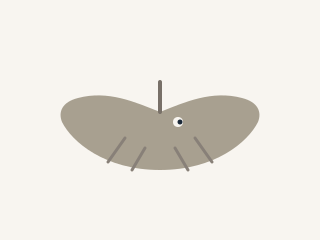
Fish
Skate
Skate (and closely related rays) yield wing “fillets” of striated muscle over cartilage, not a conventional backbone. Cooked correctly, the flesh slips off in long, scallop-like strands with a mild, slightly sweet flavour. Like shark, poorly handled skate develops an ammonia smell from urea breakdown—fresh wings should smell of the sea only. Classic French skate with brown butter and capers (raie au beurre noir) remains the reference dish; poaching, roasting, and frying also work. Remove or cook past the cartilage; many fishmongers sell skinned, prepared wings. Choose firm, translucent flesh and cook the day you buy when possible.
Track this ingredient
Cuts & parts










Breeds & varieties
A sample of named types with their own origin and culinary profiles.


Characteristics
Preparations
Provenance
Sources
Traits
Nutrition and pairings
Nutrition
Typical values per 100 g edible portion. Nutrient names open the reference page.
Nutrition Facts
Per 100 g edible portion
Amount per 100 g
- Total Fat 4.67 g
- Saturated Fat 1.01 g
- Trans Fat 0 g
- Monounsaturated Fat 2.01 g
- Polyunsaturated Fat 1.91 g
- Cholesterol 51.8 mg
- Sodium 76.5 mg
- Salt 0.19 g
- Total Carbohydrate 0 g
- Dietary Fibre 0 g
- Total Sugars 0 g
- Complex / starch 0 g
- Protein 20.9 g
- Water 72.8 g
- Energy 138 kcal
- Water 72.8 g
- Protein 20.9 g
- Animal Protein 19.9 g
- Fat 4.67 g
- Saturated Fat 1.01 g
- Monounsaturated Fat 2.01 g
- Polyunsaturated Fat 1.91 g
- Vitamins 44.7 mg
- Vitamin A 20 µg
- Vitamin B1 — Thiamine 0.1 mg
- Vitamin B2 — Riboflavin 0.14 mg
- Vitamin B3 — Niacin 3.73 mg
- Vitamin B5 — Pantothenic Acid 0.65 mg
- Vitamin B6 0.37 mg
- Vitamin B7 — Biotin 2.7 µg
- Vitamin B9 — Folate 10.7 µg
- Vitamin B12 — Cobalamin 2.1 µg
- Vitamin C 2 mg
- Vitamin D 1.3 µg
- Vitamin E 0.52 mg
- Vitamin K 0.4 µg
- Minerals 466 mg
- Major Minerals 349 mg
- Trace Minerals 118 mg
- Salt 0.19 g
- Sodium Chloride 0.19 g
- Cholesterol 51.8 mg
Vitamins
vitamin-c: 2 · vitamin-b12-cobalamin: 2.1 · vitamin-a: 20 · vitamin-b1-thiamine: 0.1 · vitamin-b2-riboflavin: 0.14 · vitamin-b3-niacin: 3.73 · vitamin-b5-pantothenic-acid: 0.65 · vitamin-b6: 0.37 · vitamin-b7-biotin: 2.7 · vitamin-b9-folate: 10.7 · vitamin-d: 1.3 · vitamin-e: 0.52 · vitamin-k: 0.4 ·
Minerals
Sodium: 76.53 · Potassium: 216 · Calcium: 56 · Iron: 1.1 · Zinc: 0.4 · Iodine: 116 ·
Fish flesh is lean to oily depending on species; marine omega-3s rise in fatty fish.
History
Coastal and river fishing for skate and related species supplied essential protein long before agriculture spread globally.
Salting, drying, smoking, and fermenting extended the shelf life of skate and enabled long-distance trade.
Ice preservation and railway transport brought fresh skate to inland cities beyond fishing ports.
Industrial freezing, aquaculture, and global logistics made skate widely available in international markets.