
Fish
Yellowtail
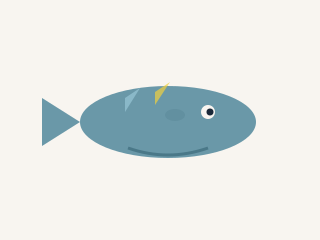
Yellowtail in sushi contexts usually means Japanese amberjack (Seriola quinqueradiata, hamachi/buri) or related Seriola jacks—firm, buttery white-to-pink flesh with a rich, clean oiliness prized raw. California yellowtail (S. lalandi) and other regionals share the family traits. Not a tuna; the fat is distributed differently and the flavour is milder and more buttery than ahi. Slice for sashimi and nigiri, sear the skin side for tataki, grill collars, or braise belly. Farmed hamachi supplies much of the restaurant trade with consistent fat. Keep ice-cold for raw service; cook gently if heat is used so the oil does not taste heavy. Check local names—yellowtail can mean different jacks by coast.
Track this ingredient
Cuts & parts










Breeds & varieties
A sample of named types with their own origin and culinary profiles.


Characteristics
Preparations
Provenance
Sources
Traits
Nutrition and pairings
Nutrition
Typical values per 100 g edible portion. Nutrient names open the reference page.
Nutrition Facts
Per 100 g edible portion
Amount per 100 g
- Total Fat 5.05 g
- Saturated Fat 0.93 g
- Trans Fat 0 g
- Monounsaturated Fat 1.95 g
- Polyunsaturated Fat 1.85 g
- Cholesterol 59.1 mg
- Sodium 79.3 mg
- Salt 0.19 g
- Total Carbohydrate 0 g
- Dietary Fibre 0 g
- Total Sugars 0 g
- Complex / starch 0 g
- Protein 20.9 g
- Water 74.1 g
- Energy 127 kcal
- Water 74.1 g
- Protein 20.9 g
- Animal Protein 19.9 g
- Fat 5.05 g
- Saturated Fat 0.93 g
- Monounsaturated Fat 1.95 g
- Polyunsaturated Fat 1.85 g
- Vitamins 50.6 mg
- Vitamin A 20 µg
- Vitamin B1 — Thiamine 0.08 mg
- Vitamin B2 — Riboflavin 0.12 mg
- Vitamin B3 — Niacin 4.72 mg
- Vitamin B5 — Pantothenic Acid 0.82 mg
- Vitamin B6 0.46 mg
- Vitamin B7 — Biotin 3.4 µg
- Vitamin B9 — Folate 13.7 µg
- Vitamin B12 — Cobalamin 2.3 µg
- Vitamin C 2 mg
- Vitamin D 1.7 µg
- Vitamin E 0.67 mg
- Vitamin K 0.6 µg
- Minerals 475 mg
- Major Minerals 355 mg
- Trace Minerals 120 mg
- Salt 0.19 g
- Sodium Chloride 0.19 g
- Cholesterol 59.1 mg
Vitamins
vitamin-c: 2 · vitamin-b12-cobalamin: 2.3 · vitamin-a: 20 · vitamin-b1-thiamine: 0.08 · vitamin-b2-riboflavin: 0.12 · vitamin-b3-niacin: 4.72 · vitamin-b5-pantothenic-acid: 0.82 · vitamin-b6: 0.46 · vitamin-b7-biotin: 3.4 · vitamin-b9-folate: 13.7 · vitamin-d: 1.7 · vitamin-e: 0.67 · vitamin-k: 0.6 ·
Minerals
Sodium: 79.32 · Potassium: 218 · Calcium: 58 · Iron: 1.3 · Zinc: 0.4 · Iodine: 118 ·
Fish flesh is lean to oily depending on species; marine omega-3s rise in fatty fish.
In the kitchen
Culinary partners and combinations that usually underperform with Yellowtail.
Pairs well with
Classic and complementary matches
- Ginger
- Sesame Seed
- Soy Sauce
- Spring Onion
- Wasabi
- YuzuJapanese hamachi
Grading systems
Grades are placed along a shared scale so systems can be compared side by side.
History
Coastal and river fishing for yellowtail and related species supplied essential protein long before agriculture spread globally.
Salting, drying, smoking, and fermenting extended the shelf life of yellowtail and enabled long-distance trade.
Ice preservation and railway transport brought fresh yellowtail to inland cities beyond fishing ports.
Industrial freezing, aquaculture, and global logistics made yellowtail widely available in international markets.