
Fish
Dab
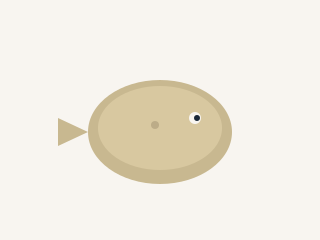
Dab (Limanda limanda) is a small North Atlantic flatfish with fine, sweet white flesh and thin fillets. It is milder and more delicate than plaice of equal size, with a soft flake that rewards gentle pan-frying whole or as skinned fillets. Because individuals are modest, whole grilled or meunière-style fish often beat elaborate filleting for home cooks. It is a traditional British and North Sea market fish—everyday rather than luxury sole—valued when very fresh. Cook the same day if possible; the flesh softens quickly. Dust lightly with flour, brown in butter, and finish with lemon or brown butter and capers; avoid heavy sauces that bury the subtle taste.
Track this ingredient
Cuts & parts



Breeds & varieties
A sample of named types with their own origin and culinary profiles.


Characteristics
Preparations
Provenance
Sources
Traits
Nutrition and pairings
Nutrition
Typical values per 100 g edible portion. Nutrient names open the reference page.
Nutrition Facts
Per 100 g edible portion
Amount per 100 g
- Total Fat 5.4 g
- Saturated Fat 1 g
- Trans Fat 0 g
- Monounsaturated Fat 1.84 g
- Polyunsaturated Fat 1.94 g
- Cholesterol 54 mg
- Sodium 80.2 mg
- Salt 0.19 g
- Total Carbohydrate 0 g
- Dietary Fibre 0 g
- Total Sugars 0 g
- Complex / starch 0 g
- Protein 20.3 g
- Water 74.8 g
- Energy 139 kcal
- Water 74.8 g
- Protein 20.3 g
- Animal Protein 19.3 g
- Fat 5.4 g
- Saturated Fat 1 g
- Monounsaturated Fat 1.84 g
- Polyunsaturated Fat 1.94 g
- Vitamins 46.1 mg
- Vitamin A 20 µg
- Vitamin B1 — Thiamine 0.1 mg
- Vitamin B2 — Riboflavin 0.15 mg
- Vitamin B3 — Niacin 3.96 mg
- Vitamin B5 — Pantothenic Acid 0.69 mg
- Vitamin B6 0.39 mg
- Vitamin B7 — Biotin 2.9 µg
- Vitamin B9 — Folate 11.4 µg
- Vitamin C 2 mg
- Vitamin D 1.4 µg
- Vitamin E 0.56 mg
- Vitamin K 0.5 µg
- Minerals 327 mg
- Major Minerals 270 mg
- Trace Minerals 56.4 mg
- Salt 0.19 g
- Sodium Chloride 0.19 g
- Cholesterol 54 mg
Vitamins
vitamin-c: 2 · vitamin-b12-cobalamin: 2 · vitamin-a: 20 · vitamin-b1-thiamine: 0.1 · vitamin-b2-riboflavin: 0.15 · vitamin-b3-niacin: 3.96 · vitamin-b5-pantothenic-acid: 0.69 · vitamin-b6: 0.39 · vitamin-b7-biotin: 2.9 · vitamin-b9-folate: 11.4 · vitamin-d: 1.4 · vitamin-e: 0.56 · vitamin-k: 0.5 ·
Minerals
Sodium: 80.15 · Potassium: 155 · Calcium: 35 · Iron: 1 · Zinc: 0.4 · Iodine: 55 ·
Fish flesh is lean to oily depending on species; marine omega-3s rise in fatty fish.
History
Coastal and river fishing for dab and related species supplied essential protein long before agriculture spread globally.
Salting, drying, smoking, and fermenting extended the shelf life of dab and enabled long-distance trade.
Ice preservation and railway transport brought fresh dab to inland cities beyond fishing ports.
Industrial freezing, aquaculture, and global logistics made dab widely available in international markets.