
Processed
Potassium Bicarbonate
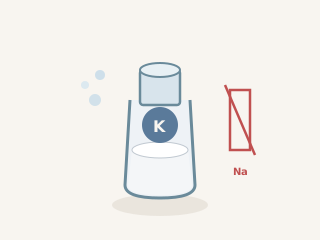
Potassium bicarbonate is an alkaline salt used as a chemical leavener and pH buffer, offering a sodium-free alternative to baking soda in reduced-sodium bakery and some beverage systems. With acid ingredients it releases carbon dioxide for lift in cookies, muffins, and mixes; formulators adjust acid type and level because potassium salts can taste slightly different from sodium bicarbonate at equal alkalinity. It also appears as a wine deacidification agent and as a food-grade acidity regulator in specialised products. The refined powder is white, free-flowing, and hygroscopic enough to need dry storage. Food and pharmaceutical grades control heavy metals, assay, and particle size. In leavening blends it may be combined with cream of tartar, monocalcium phosphate, or other acids; alone it still requires recipe acid and moisture to perform.
Also known as: E501(ii), Potassium bicarbonate
Track this ingredient
Explore further


Breeds & varieties
A sample of named types with their own origin and culinary profiles.




Characteristics
Preparations
Provenance
Sources
Traits
Nutrition and pairings
Nutrition
Typical values per 100 g edible portion. Nutrient names open the reference page.
Nutrition Facts
Per 100 g edible portion
Amount per 100 g
- Total Fat 0 g
- Saturated Fat 0 g
- Trans Fat 0 g
- Monounsaturated Fat 0 g
- Polyunsaturated Fat 0 g
- Cholesterol 0 mg
- Sodium 0 mg
- Salt 0 g
- Total Carbohydrate 0 g
- Dietary Fibre 0 g
- Total Sugars 0 g
- Complex / starch 0 g
- Protein 0 g
- Water 0.2 g
- Water 0.2 g
- Minerals 39100 mg
- Major Minerals 39100 mg
- Potassium 39100 mg
Minerals
Potassium bicarbonate is the potassium analogue of baking soda, used as a low-sodium alkali leavener and pH buffer. It is an inorganic salt: 0 kcal, 0 macros. Potassium is about 39% of the formula weight (~39100 mg/100 g); sodium is absent.
History
Potassium bicarbonate entered chemical and early food use as a soluble alkaline carbonate salt.
Reduced-sodium product development explored potassium bicarbonate as a baking-soda stand-in.
Wine makers used potassium bicarbonate more systematically for tartaric deacidification.
Clean-label and low-sodium bakery lines expanded food-grade potassium bicarbonate demand.